
Bulletin #220 - Sept 2026
ICS Celebrates Churchill & America

October 1, 2026
By Adam Howard, Executive Director
Winston Churchill’s relationship with America was both deeply personal and profoundly consequential. Proudly half-American through his mother, Jennie Jerome, Churchill maintained a lifelong connection to the United States. Across his numerous visits, from his early travels and lecture tours to his wartime and postwar diplomacy, he formed important relationships with Americans who shaped both his thinking and his career. These ranged from early friends and mentors such as Bourke Cockran and Bernard Baruch, through his wartime relationships with Franklin D. Roosevelt and Averell Harriman, to his postwar friendships with Harry Truman and Dwight D. Eisenhower. Together, these relationships reflected Churchill’s enduring affection for America and his conviction that the partnership between Britain and the United States mattered profoundly to the wider world.
As we prepare for the 2026 International Churchill Conference in Philadelphia, October 15–17, I am especially excited that we will explore this extraordinary relationship during America’s 250th anniversary. Our theme, Churchill & America, offers an opportunity to examine the historical, political, and personal connections that bound Churchill to the United States and continue to resonate today.
Our conference will bring together distinguished historians, authors, and leaders to explore Churchill’s American heritage, the friendships he forged with Americans throughout his life, his relationships with Roosevelt, Truman, and Eisenhower, his admiration for American democracy, and the enduring importance of the transatlantic relationship. From our opening reception at the Museum of the American Revolution to our sessions at the historic Union League of Philadelphia, we have an exceptional program planned in a city that played such a central role in America’s founding.
I am particularly looking forward to welcoming returning members, first-time attendees, and friends from across the United States and around the world. Our annual conference is more than an opportunity to study history. It is a chance to renew friendships, exchange ideas, and strengthen the community that makes the International Churchill Society so special.
With only a few weeks until we gather in Philadelphia, our excitement continues to build. I look forward to seeing many of you there as we celebrate Churchill’s remarkable connection to America and the shared history that continues to unite our two nations.
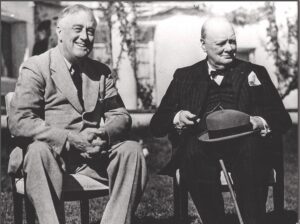
Churchill needed Roosevelt, while Roosevelt had to navigate U.S. public opinion and domestic politics. Their national interests did not always align, yet they continued talking, and their relationship grew into something deeper than a diplomatic partnership. After Roosevelt’s death in April 1945, Churchill expressed profound sadness at the loss of his friend and partner. Their friendship had not eliminated disagreement or national self-interest. It had created something more valuable: enough trust to manage both.
That is what makes their relationship so relevant today. International partnerships are often discussed in terms of treaties, institutions, military capabilities, and economic interests. All of those things matter. But Churchill and Roosevelt remind us that leadership remains profoundly personal. Relationships must be built before they are tested, trust requires time, and communication must continue even when agreement is difficult. Effective leaders must understand not only what their partners need, but also the political constraints under which they operate.
As we mark the eighty-fifth anniversary of the Atlantic Charter, Hyde Park offers a powerful reminder that history is shaped not only by great declarations, but by the relationships behind them. Churchill and Roosevelt changed the course of the twentieth century because they learned how to work together despite profound differences. That remains one of the enduring lessons of their partnership and one of the clearest reasons Churchill still matters.
Join ICS, stay connected, and be part of the ongoing work to preserve, interpret, and share Churchill’s legacy for a new generation.





Subscribe
WANT MORE?
Get the Churchill Bulletin delivered to your inbox once a month.