
Bulletin #219 - Aug 2026
Churchill, Roosevelt, and the Power of Relationships

August 31, 2026

By Adam Howard, Executive Director
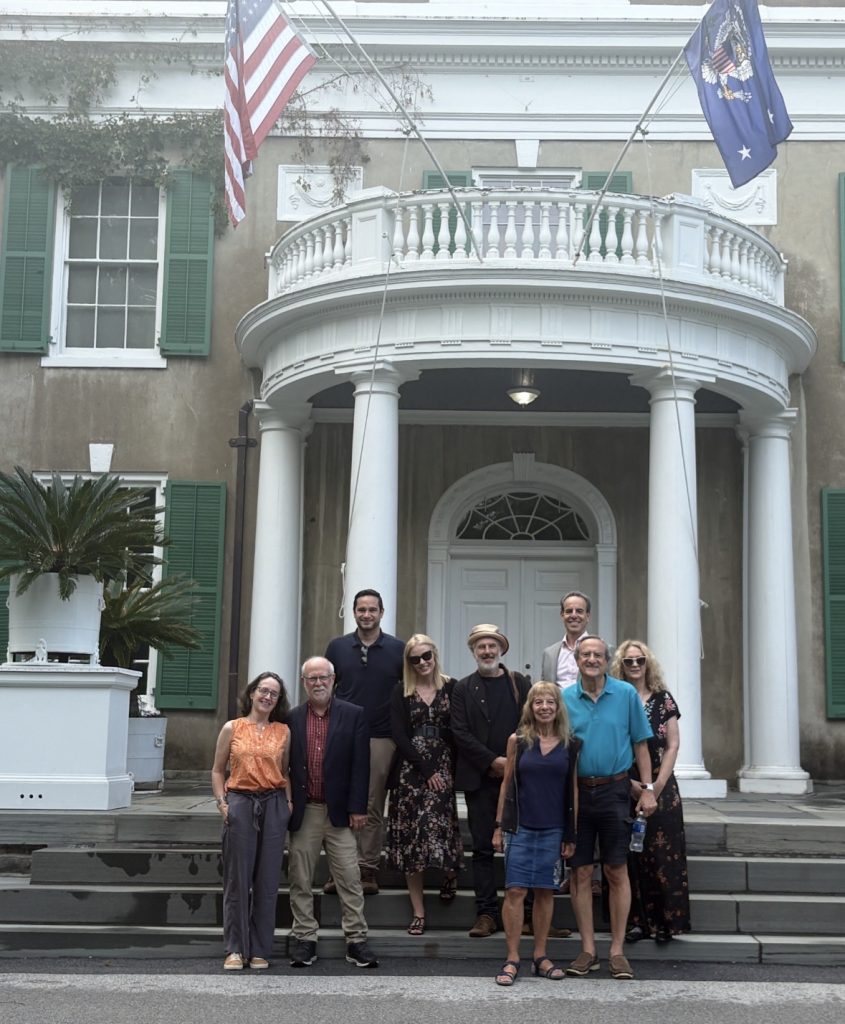
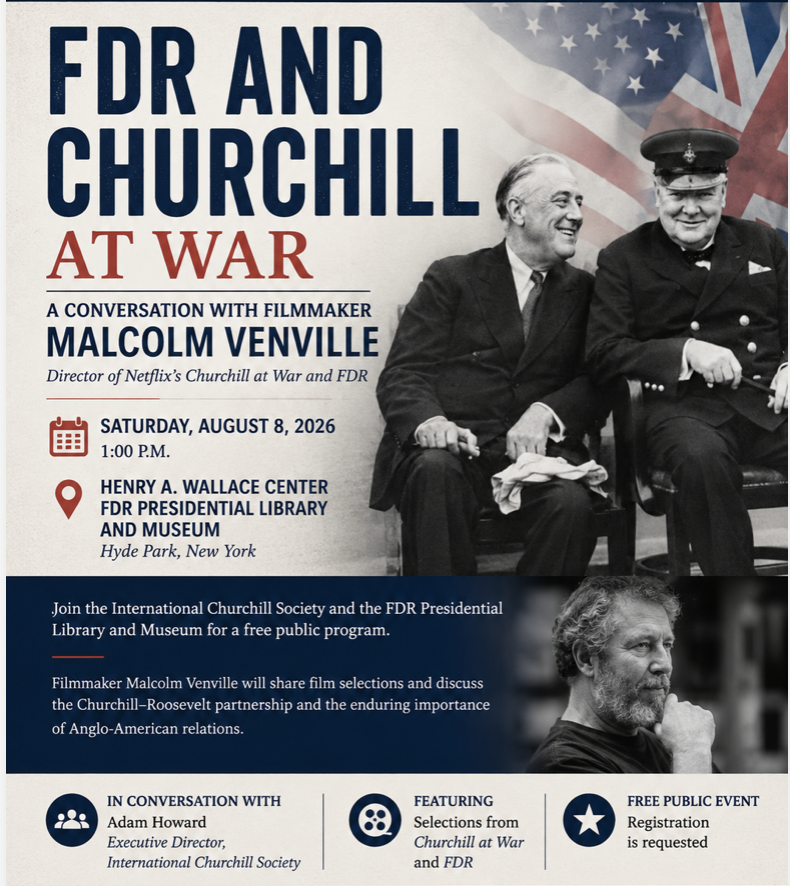
This month, I had the privilege of visiting Hyde Park, New York, where I took part in a conversation with filmmaker Malcolm Venville about Winston Churchill and Franklin Roosevelt. It was an especially fitting place to reflect on one of the most important relationships of the twentieth century.
Through his work on the docudramas Churchill at War and FDR, Malcolm has spent significant time examining Churchill and Roosevelt as people rather than simply as icons. Both men possessed enormous confidence, political skill, theatrical instinct, and force of personality. Both also understood how deeply effective leadership depended upon communication and human connection.
They were, however, very different men. They came from distinct political systems and traditions, and their national interests did not always align. Yet during the Second World War, they forged a relationship marked by extraordinary communication, trust, candor, humor, and persistence.
Churchill later recalled more than 1,700 wartime messages exchanged with Roosevelt. Their nine wartime meetings amounted to roughly 120 days of close personal contact. But the numbers only begin to explain why the relationship mattered. Churchill understood that alliances were sustained by people as much as by agreements. He wrote frequently, crossed the Atlantic repeatedly, stayed in Roosevelt’s home, shared meals, exchanged jokes, and pressed his case directly. Roosevelt, in turn, opened his home and presidency to Churchill, helping transform a diplomatic relationship into something closer to a genuine partnership.
Hyde Park brings that history into sharper focus. Churchill visited Roosevelt there three times between 1942 and 1944, spending time with the president not simply as an allied leader but as a personal guest. Away from the formal settings of wartime conferences, the two men could talk, dine, and conduct serious business in a more intimate environment. Much of leadership happens away from the podium, in conversations, relationships, and the gradual accumulation of trust.
The Atlantic Charter offers a particularly revealing example. When Churchill headed to Placentia Bay in August 1941, his principal objective was to bring the United States into the war. Failing that, he hoped to secure greater U.S. military assistance and stronger U.S. action against the Axis. He therefore arrived expecting that his meeting with Roosevelt might produce something more concrete than a statement of principles. Roosevelt, however, could not commit the United States to war. Instead, he wanted the two leaders to articulate a common vision for the postwar world. The result was the Atlantic Charter, a statement of shared principles that helped bind the two countries more closely together and gave the British government an important diplomatic and political victory.
The Charter’s idealistic language, however, masked real tensions. Roosevelt’s commitment to freer trade challenged Britain’s system of imperial preference, while the Charter’s language about the right of peoples to choose their own form of government raised difficult questions about the future of the British Empire. Churchill therefore faced a difficult political calculation. He needed U.S. support while also managing opposition within his own government and Conservative Party to policies that appeared to threaten Britain’s imperial and economic interests. The Charter represented genuine agreement, but its language also left room for each leader to interpret its principles according to his own national interests and political realities.
Churchill also recognized the need to preserve room for different interpretations of the Charter. He was particularly concerned that its language about self-government could eventually be applied to Britain’s colonies. He therefore emphasized that the Charter’s principles did not require Britain to dismantle its empire or abandon imperial preference. This flexibility allowed the two leaders to present a united front while postponing disputes they could not resolve in the middle of a war.
The episode is a useful reminder that diplomacy is rarely as simple as the final document makes it appear. The Atlantic Charter represented genuine agreement, but it also left room for each leader to interpret its principles according to his own national interests and political realities. That flexibility was possible in part because Churchill and Roosevelt had built a relationship strong enough to withstand disagreement.
Churchill needed Roosevelt, while Roosevelt had to navigate U.S. public opinion and domestic politics. Their national interests did not always align, yet they continued talking, and their relationship grew into something deeper than a diplomatic partnership. After Roosevelt’s death in April 1945, Churchill expressed profound sadness at the loss of his friend and partner. Their friendship had not eliminated disagreement or national self-interest. It had created something more valuable: enough trust to manage both.
That is what makes their relationship so relevant today. International partnerships are often discussed in terms of treaties, institutions, military capabilities, and economic interests. All of those things matter. But Churchill and Roosevelt remind us that leadership remains profoundly personal. Relationships must be built before they are tested, trust requires time, and communication must continue even when agreement is difficult. Effective leaders must understand not only what their partners need, but also the political constraints under which they operate.
As we mark the eighty-fifth anniversary of the Atlantic Charter, Hyde Park offers a powerful reminder that history is shaped not only by great declarations, but by the relationships behind them. Churchill and Roosevelt changed the course of the twentieth century because they learned how to work together despite profound differences. That remains one of the enduring lessons of their partnership and one of the clearest reasons Churchill still matters.
Join ICS, stay connected, and be part of the ongoing work to preserve, interpret, and share Churchill’s legacy for a new generation.




Subscribe
WANT MORE?
Get the Churchill Bulletin delivered to your inbox once a month.