Bulletin #218 - July 2026
Where Churchill and Roosevelt Changed the World
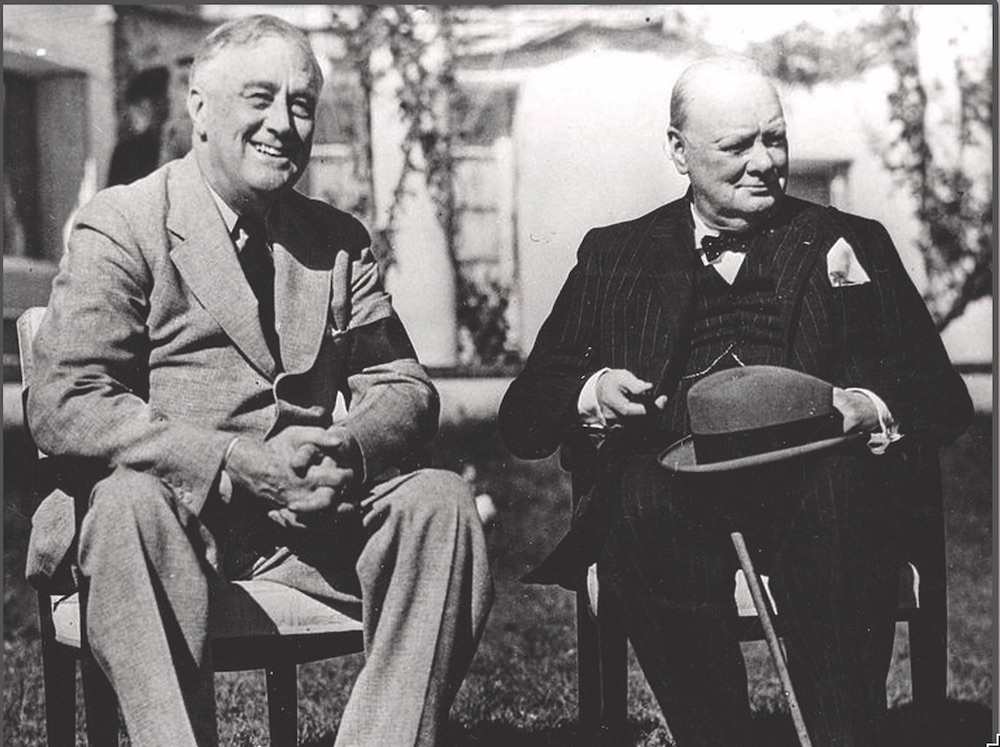
Franklin Roosevelt and Winston Churchill
July 29, 2026
By Adam Howard, Executive Director
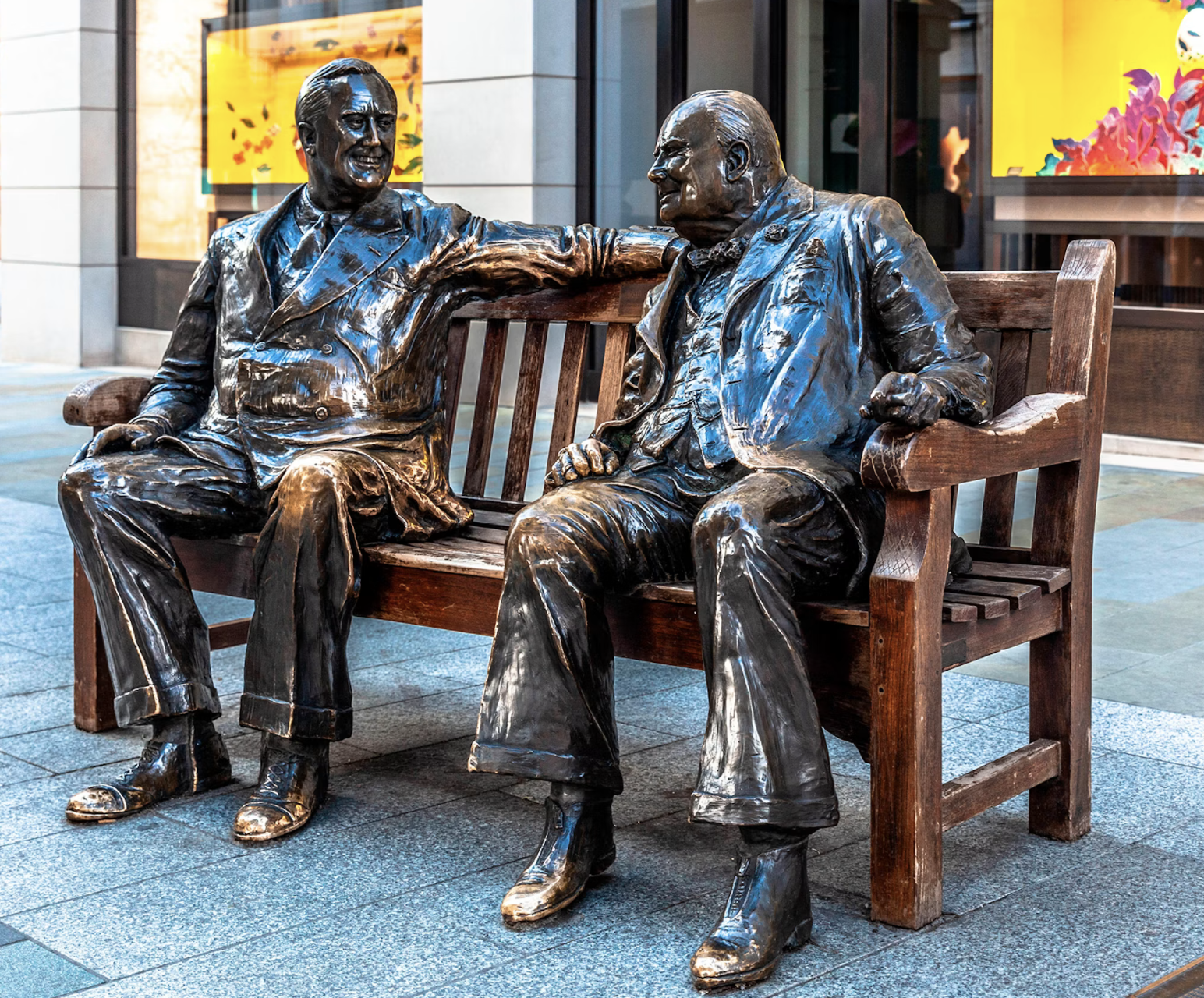
History often remembers great speeches, famous photographs, and decisive battles. Less often do we pause to consider the relationships that made those victories possible. Few partnerships shaped the modern world more profoundly than the bond between Winston Churchill and Franklin Delano Roosevelt.
The “Special Relationship” between the United States and the United Kingdom did not emerge automatically from a shared language or common heritage. It was built deliberately through trust, persistence, and a shared recognition that the future of democracy depended upon cooperation between the two nations.
From early in his political career, Churchill recognized the growing power of the United States and believed that Britain should cultivate close Anglo-American cooperation. During the opening months of World War II, he understood that Britain’s ability to sustain the conflict and ultimately achieve victory would depend heavily upon U.S. material, financial, and eventually military support.
Roosevelt, constrained by public opinion and official U.S. neutrality, nevertheless recognized that the conflict threatened far more than Europe. Between 1939 and 1945, the two leaders exchanged nearly 2,000 letters, telegrams, and messages. Their correspondence reveals not only strategy and diplomacy, but also candor, humor, persuasion, and an extraordinary degree of personal trust.
Their most consequential early meeting took place in August 1941, months before the United States formally entered the war. Aboard naval vessels off Newfoundland, Churchill and Roosevelt developed the Atlantic Charter. Its principles were ambitious: self-determination, economic cooperation, freedom of the seas, and collective security. Churchill had reservations about language that might be interpreted as applying self-determination directly to Britain’s empire, but he accepted the Charter after framing its immediate meaning around the restoration of nations conquered by Nazi Germany.
In doing so, he set aside his concerns in favor of a broader statement of shared Anglo-American purpose, allowing the Charter to become a powerful declaration of Allied war aims and a foundation for the United Nations and the postwar liberal order. Churchill later described the meeting as one of the most important of his life. Roosevelt understood that U.S. public opinion had to be moved gradually, but decisively.
Their partnership continued through years of war, strategic disagreement, and immense political pressure. Churchill needed U.S. action. Roosevelt had to move a divided nation carefully but decisively toward engagement. Together, they coordinated Allied strategy and demonstrated that the strongest alliances are grounded not simply in shared interests, but in shared convictions.
Hyde Park, Roosevelt’s lifelong home in New York, played an important role in that history. During Churchill’s first wartime visit there in June 1942, the two leaders discussed pooling British and American atomic research and sharing their findings, an early step in the cooperation that would eventually produce the Manhattan Project. Churchill returned in September 1944, when he and Roosevelt confronted questions about Germany’s future, the war against Japan, and the emerging challenge posed by the Soviet Union. During that visit, they signed the Hyde Park Aide-Mémoire, reaffirming Anglo-American cooperation on atomic development. The document was brief, but its implications were enormous.
Churchill returned once more in March 1946, after Roosevelt’s death, to lay a wreath at his friend’s grave in a solemn tribute to both their personal relationship and the historic partnership they had forged.
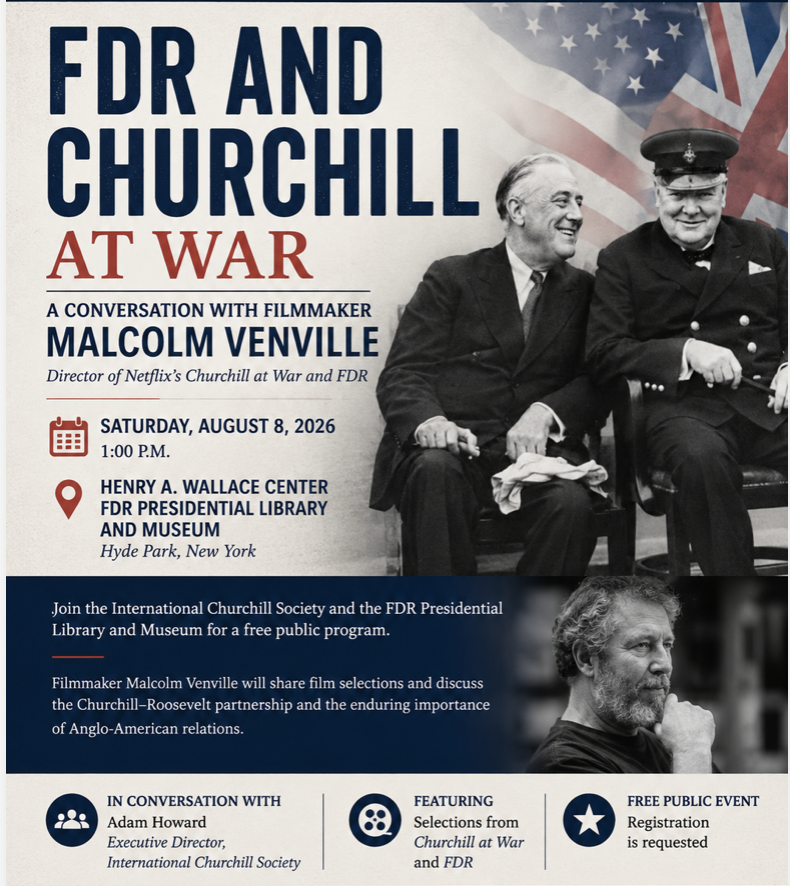
This August, the International Churchill Society will return to Hyde Park to examine the leadership, trust, and strategic vision that defined the Churchill-Roosevelt partnership. We are especially pleased to welcome filmmaker Malcolm Venville, director of Churchill at War and FDR, for a public presentation at the Franklin D. Roosevelt Presidential Library and Museum.
The presentation is free and open to the public. International Churchill Society members will receive premier seating. While the larger weekend program is reserved for registered participants, this public session offers everyone an opportunity to hear Malcolm Venville discuss the two leaders, the making of his acclaimed historical films, and why the Churchill-Roosevelt partnership continues to matter.
As America marks its 250th anniversary, the lessons of Churchill and Roosevelt remain strikingly relevant. Their partnership reminds us that democracy requires leadership, alliances require trust, and freedom depends upon the willingness of nations to act together in defense of shared values.
We hope you will join us at Hyde Park for this special public program and for a deeper look at the relationship that helped shape the twentieth century.
Join ICS, stay connected, and be part of the ongoing work to preserve, interpret, and share Churchill’s legacy for a new generation.



Subscribe
WANT MORE?
Get the Churchill Bulletin delivered to your inbox once a month.