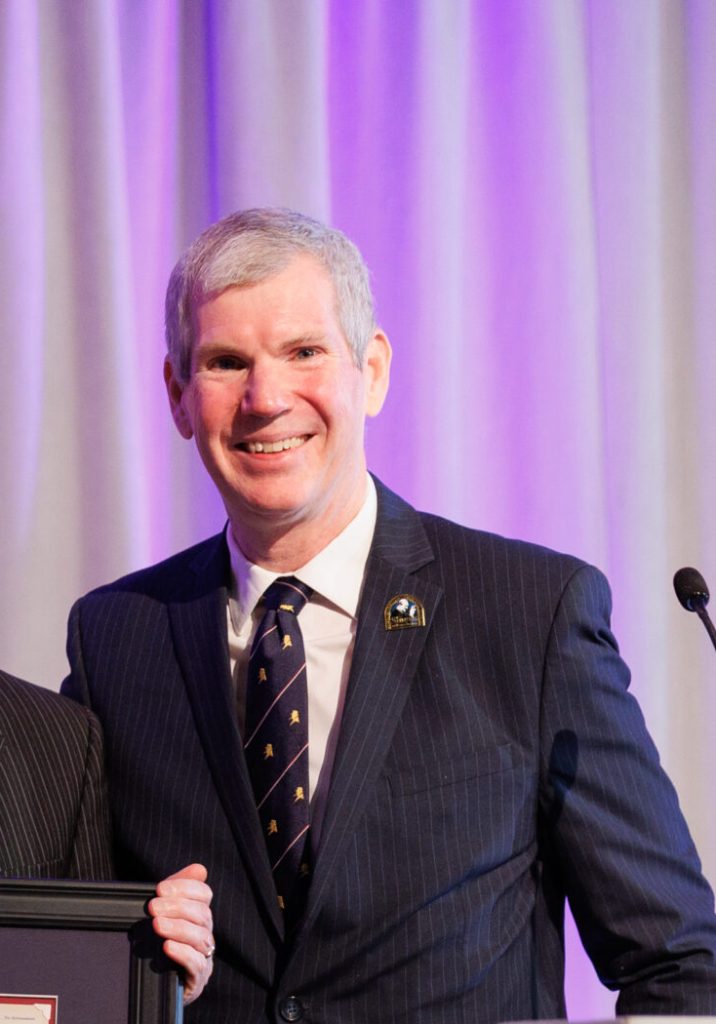
The Hottest Ticket in Town, 1946 By Donald P. Lofe, Jr. President and Chief Transformation Officer and Churchill Fellow, Westminster CollegeDirector, International Churchill Societ...
Although he’d sought to delay it as long as he could, at last Churchill had to accept that the invasion of Europe from the French coast was going to take place. Britain had become the minor player in the Anglo-American partnership and Churchill had to face the fact that he no longer had the influence to prevent what he saw as an incredibly risky operation. His walk with ‘Destiny’ was now several paces behind the Americans.
Despite Churchill’s visits to Paris to stiffen French resolve, his attempts proved futile as the German blitzkrieg shattered the French resistance and drove the British Expeditionary Force back to the Channel ports. A pause in the German attacks between 27 May and 4 June allowed the evacuation of over three hundred thousand British and French troops from the beaches at Dunkirk – turning what was in reality a colossal military disaster into what came to be seen as a success; the saving of lives by the ‘little ships’ (fishing boats, pleasure craft, lifeboats) that ferried men to the destroyers waiting offshore. For more on Dunkirk, and a collection of personal accounts from some of those who took part in the mass evacuation, see the BBC’s Archive . Britain was now clearly in Hitler’s sights. Vulnerable, weakened by defeat on the beaches of France (and with much of its weaponry and ammunition left on French shores), and a long way from its empire and commonwealth allies, it faced the might of the German army and air force alone.
Churchill later claimed, in that embarking on a military career ‘was entirely due to my collection of soldiers’, although the influence of Blenheim and his ancestor’s glories on the battlefield, as well as Churchill’s determination to follow his father into politics (for which he regarded the army as a great training ground), probably also played key roles. His toy soldier collection, based on the toy army he played with at Blenheim, was set up as an infantry division and he and his brother Jack, even in their teens, played out famous battles, with Jack’s soldiers playing the enemy.
In 1900, most Londoners ate their meals at home. Most working men returned home for their midday meal and those who didn’t ate plain British food in plain British ‘chophouses’. Wealthy men dined out at their clubs or, if they were very adventurous, at French restaurants. During the Second World War, restaurants were initially exempt from rationing; the wealthy were supplementing their rations by eating ‘luxury’ off-ration food. This was strongly resented by those unable to afford to eat out; new restrictions were introduced in May 1942 so that restaurants weren’t able to charge more than five shillings per customer and meals couldn’t be more than three courses (and only one of these could contain meat or fish or poultry). But even restaurants couldn't always offer escape from the monotony of potatoes, oats and cabbage: in 1944 Simpson's-in-the-Strand was serving Creamed Spam Casserole.
In 1917, when Germany began sinking ships that were bringing food (and military equipment) to Britain, and the country had just six weeks' food left, the Government initiated the rationing of food supplies. Even after the end of the war, sugar and butter remained rationed until 1920. Bread was subsidized but in 1917, British people were told to eat twenty five per cent less. Even the fighting troops had their food rationed. Compare . The US faced similar issues during the First World War. The country was in a severe economic depression, with many living in poverty, and .
During the war, Churchill had one great asset that Hitler seemingly lacked; a brilliant team of crypto-analysts at the Government Communications HQ at Bletchley Park, Buckinghamshire. The deciphered radio intercepts known as Ultra far outclassed anything the Germans achieved. It remained one of the most closely guarded secrets of the war.
V H Mottram’s (1932) gives recipes to help families economise: For the “really poor”, ingredients include white and brown bread, suet white flour, rice, tapioca, sago, potatoes, dates, currants and figs. For the “merely poor”: butter, parsnips, raisins, milk, sweet biscuits, some pork and beef. Those on a ‘moderate income’ could turn to (1937), with twelve menus for breakfasts, luncheons and dinners for all four seasons. Recipes included salmon mayonnaise, roast fowl, asparagus with cream sauce, oysters , fillets of Beef a la St Aubyn, roast partridge and all kinds of fish – fresh, saltwater and shellfish.
In his last youthful military adventure, Churchill joined British forces in the Boer War. Churchill set off, armed with the important things in life – sixty bottles of spirits, twelve bottles of Rose’s Lime Juice and a supply of claret – and arrived in Cape Town late on 30 October 1899. He was famously captured only two weeks later by the Boers, when the armoured train on which he was travelling in Boer-occupied territory was ambushed and derailed. He made a dramatic escape the following month, making his way to Durban, with the Boers offering a reward of £25 for the recapture of their well-known prisoner, ‘dead or alive’. His dispatches from the Boer War were republished as two books, (1900) and (1900).
On his return to London from India, Churchill – keen to get into politics – made a speech at a political meeting in Bradford. But he also desperately wanted to join Kitchener’s army in the Sudan: he saw action in the field – and writing about it – as a way to gain further attention. Persistent as ever, Churchill managed to obtain a temporary commission as a Lieutenant with the 21 Lancers while again also serving as a war correspondent, this time for the . In August 1898 he set off on his next adventure – travelling up the Nile with the expeditionary force under General Kitchener.
International Churchill Society the preeminent member organization dedicated to preserving the historic legacy of The Rt. Hon. Sir Winston Churchill.
Get the Churchill Bulletin delivered to your inbox once a month.
Join the International Churchill Society today! Membership starts at just $29/year.