
Bulletin #218 - July 2026
Why Churchill Matters – Churchill as American
July 29, 2026
By Vince Benedetto, Director, International Churchill Society Board and President, Churchill Society of Pennsylvania
There are moments in life when history stops feeling distant.
Americans, in many ways, have always claimed Winston Churchill as one of their own. None other than President John F. Kennedy, during a White House ceremony in April of 1963, did so. President Kennedy proclaimed Churchill an honorary American citizen of the United States. Churchill, too frail to be present at the ceremony, sent his son, Randolph, to accept the honor. Churchill did, however, write a moving letter that his son read aloud during the ceremony. Churchill’s adoration for our American Republic shone through with his eloquent words:
“I am, as you know, half American by blood, and the story of my association with that mighty and benevolent nation goes back nearly ninety years to the day of my Father’s marriage. In this century of storm and tragedy I contemplate with high satisfaction the constant factor of the interwoven and upward progress of our peoples. Our comradeship and our brotherhood in war were unexampled. We stood together, and because of that fact, the free world now stands.”
Though he led Britain and the free world through its finest and most perilous hour, he occupies an enduring place in American hearts and minds. To this day, we invoke his ‘never surrender’ and ‘never give in’ words during competitions, corporate planning sessions, in Congress and at the White House. We study his leadership and strategies at our military academies and business schools; we keep his portraits and busts in our halls of government, libraries, cigar lounges, and private studies. We study his oratory and wordsmithing skills in public speaking and creative writing classes, remember him in toasts with the finest scotches and champagnes, and flash the victory symbol during both consequential and casual moments. He is the subject of an ever-growing number of documentaries and a recurring character in numerous TV shows and cinema. His books remain on our shelves, his speeches circulate virally and remain on the tip of our tongues, his name is invoked on a near daily basis on talk radio, and his example continues to stir people born long after the allied victory in WWII. He is, in every way, ever present in the American consciousness with no signs of fading. Indeed, it is the mission and passion of the International Churchill Society (ICS), and our affiliated chapters, to make sure it stays that way – all while safeguarding the official record of Churchill’s life and legacy!

Author at Churchill Society of Pennsylvania Victory Gala, pictured with Geovanna Benedetto and Vice Admiral Michael Franken.
To this end, we hold our most important global event each year, the International Churchill Conference. This annual gathering brings the brightest lights, leaders and scholars around the ‘Great Man’ together! The ICS will be doing this for our forty-third year this autumn, and this conference may very well be our most consequential. It’s also no accident that it happens to be our first ever gathering in Pennsylvania. This October 15th-17th, The International Churchill Society will convene in Philadelphia as the United States continues celebrating its 250th anniversary. The conference has even been designated as an official America250PA event.
The theme this year will aptly be: ‘Churchill and America’. No city could be more fitting. Philadelphia is the birthplace of American liberty. It’s where the First and Second Continental Congress gathered and where the Declaration of Independence, the Articles of Confederation, and the Constitution were signed, giving concrete form to the ideals of American liberty and self-government. This gathering will examine Churchill’s profound attachment to the United States—an attachment that helped save the free world. The connection began at birth. Churchill’s mother, Jennie Jerome, was an American from New York. From her he drew not only his American heritage but an instinctive affinity toward the United States. He took great pride in knowing his mother’s ancestry traced back to the American Revolution, where his distant relatives fought in George Washington’s army. As such, Churchill was a member of the Sons of the American Revolution and a hereditary member of the Society of the Cincinnati. He boasted that he was “half American,” and he said it with a smile that made him beam.
From his first visits to New York and Pennsylvania and through lecture tours after the Boer War, to repeated journeys across his long career, Churchill drank deeply from the American spirit. He admired the United States’ restless energy, vastness, innovative genius, republican vitality, entrepreneurial spirit and can-do optimism. He periodically grew impatient with American reluctance to more quickly confront gathering threats, yet he never doubted the Republic’s latent power—its ability, once awakened, to mobilize resources and moral force on a scale unmatched in the annals of history. America continually intertwined through his life story with drama and irony. For example, in 1931, Churchill was struck by a car on 5th Avenue in NYC after looking the wrong way before stepping into the path of an oncoming car—an Englishman’s momentary lapse in a city where we drive on the ‘other side’. He would even write a book, titled, “A History of the English-Speaking Peoples”, which covers the shared history of Britain and the United States.
During World War II, in his grand struggle to defend all that was good and true, Churchill found a kindred spirit in another leader, President Franklin Roosevelt, who became his indispensable partner. The Churchill-Roosevelt bond stands as one of history’s most consequential friendships. Two men of different temperaments, backgrounds, and political instincts forged an alliance of trust and shared purpose that altered the course of the 20th century—the ramifications of which still echo across all corners of the globe to this day. Through the Atlantic Charter, combined strategy sessions, and personal correspondence, WSC and FDR coordinated the greatest military coalition the world had ever witnessed. Their partnership demonstrated that free nations achieve their highest triumphs not through isolationism, but through magnanimous cooperation grounded in common ideals.

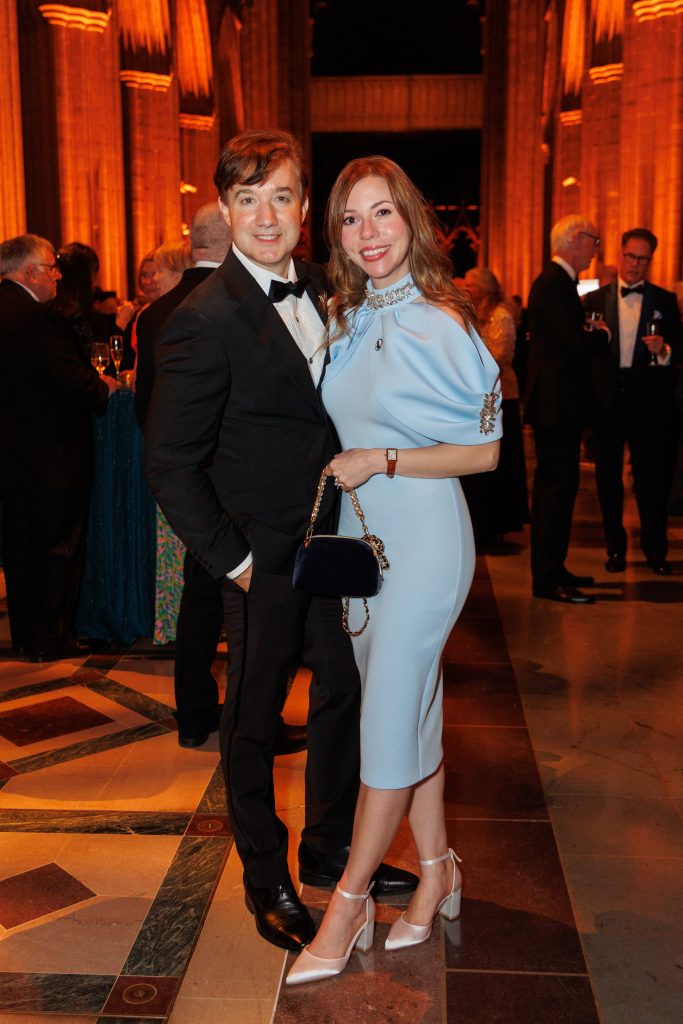
Vince and Geovanna Benedetto at Churchill Society of Pennsylvania 150th Birthday Gala, Union League of Philadelphia 2024.
Pennsylvania, and Philadelphia, hold their own ‘firsts’ in Churchill’s American journey. He first visited Philadelphia in 1900, the opening stop on his North American speaking tour on the Boer War. Churchill was also a student of the American Founding and the Civil War, studying with care the commanders and the battles. He admired George Washington and Abraham Lincoln, and even toured the Gettysburg Battlefield by helicopter with President Dwight Eisenhower. Churchill understood that the principles proclaimed in Philadelphia in 1776, and defended on the fields of Gettysburg in 1863, representative government, free speech, individual rights, and natural law, represented a shared Anglo-American inheritance. When Britain and America stood shoulder to shoulder against totalitarian darkness, they were, in Churchill’s mind, returning to their deepest common roots.
Americans’ enduring fascination with Churchill is no accident. He embodied virtues we have always associated with American greatness: courage in crisis, infectious optimism, moral clarity, mastery of language, an unyielding refusal to accept defeat, and an admiration for the underdog. In an age that often prizes things that are perishable, Churchill offers something rarer—steadfast conviction and a belief in the things that last. Churchill knew that only good things endure. He understood that America was great because America was good. He knew standing for the good gave us a power our enemies could never muster. He believed in his words that “Strength is granted to us all when we are needed to serve great causes.” By studying him, we have a better chance of discovering this strength in ourselves. He reminds us that real leadership, the type of leadership that saves civilizations, is judged ultimately by principle and courage, not by polls or momentary approval—something worth remembering at a time of instant gratification, ‘likes,’ and ‘clicks’.
Those of us who admire him often possess a special intensity in our admiration. For me, it echoes the devotion inspired by another British phenomenon I have loved since youth: The Beatles. The comparison is lighthearted, of course. It was not common for Churchill to be mobbed by screaming fans at the airport. Yet the parallel holds. Across the decades, new books about him continue to become bestsellers. His speeches have racked up millions of views online. Lecture halls fill to hear scholars revisit battles and decisions from eighty years ago. Like pilgrims, we still travel to his Cabinet War Rooms, his home at Chartwell, and his birthplace, Blenheim Palace. The enthusiasm remains remarkably fresh. We still very much live in a world order with Churchill’s name and fingerprints all over it (And let us not forget John Lennon’s middle name was, ‘Winston’).
This October, at the historic Union League of Philadelphia, combined with outings at the Museum of the American Revolution and the Grand Lodge of Pennsylvania, we will celebrate both America’s 250th birthday and the extraordinary bond between Churchill and America. I can think of no better setting to reflect on the Englishman who did so much to preserve our liberties and who forged and fostered the ‘special relationship’ between America and Britain. Churchill was, of course, British. Yet through ancestry, affection, and alliance, he was also profoundly, and uniquely, American. That dual belonging helps explain why, more than 61 years after his death, his stature continues to rise rather than recede. In honoring him, we honor the best in ourselves as Americans. Churchill still matters because the future fate of western civilization may very well be tied to the enduring love we maintain for Sir Winston, as he was its greatest admirer and defender. In the 21st Century, when so many things that anchored us for so long seem up for debate, we would be wise to continue to turn to the 20th century’s greatest statesman and remember his words: “Do not let spacious plans for a new world divert your energies from saving what is left of the old.”
Winston Churchill may technically be half-American, but we Americans love him with our whole hearts!





Subscribe
WANT MORE?
Get the Churchill Bulletin delivered to your inbox once a month.