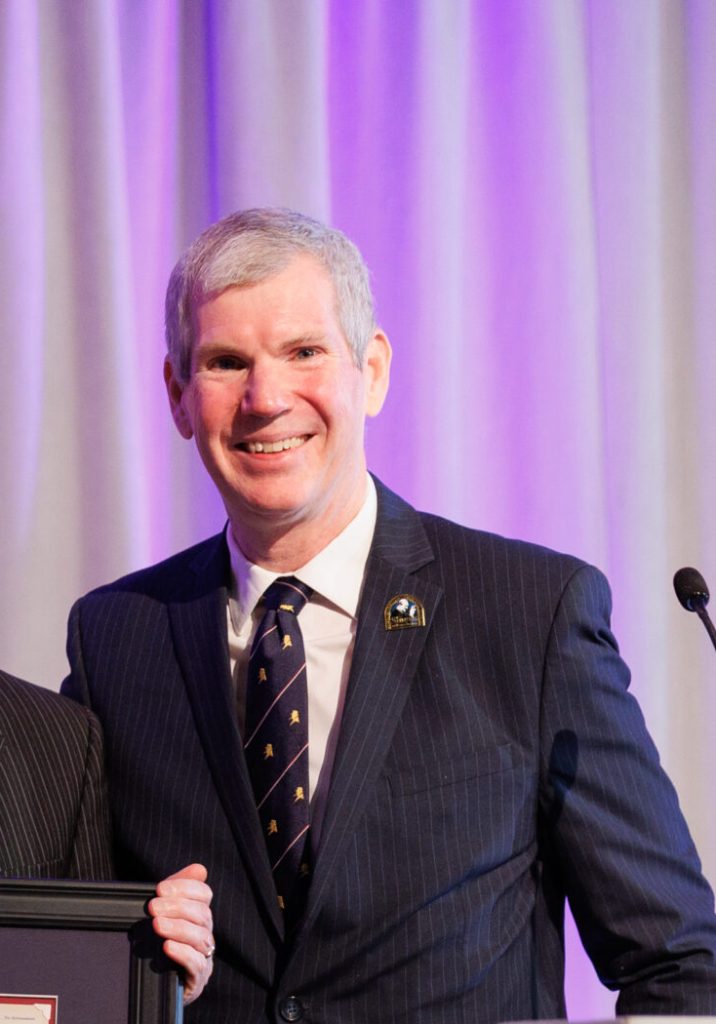
The Hottest Ticket in Town, 1946 By Donald P. Lofe, Jr. President and Chief Transformation Officer and Churchill Fellow, Westminster CollegeDirector, International Churchill Societ...
Shortly after his return from Fulton, Churchill began to write his war memoirs. With a team of researchers working on his behalf, and a very ordered (if somewhat laborious) approach to drafting and editing, he soon had the first volume finished. appeared in six volumes between 1948 and 1954. Churchill never claimed the memoirs were ‘history’; they were rather a contribution to history. Although their very breadth and coverage gave the impression that they were a definitive account, there were omissions, of course. was Churchill’s interpretation of the events, the work of a man seeking to place his role in the war – and in history. The books sold well, with a combined first printing of over 800,000 copies.
Graham Farmelo, speaking at the Winston Churchill Memorial Trust’s 50th Anniversary Fellows’ Day (Blenheim Palace, 27th May 2015), discusses Churchill’s relationship with science and technology, posing the interesting question: Was Churchill...
Back in August 1941, and the signature of the Atlantic Charter, Roosevelt hadn’t been ready or able to enter the war. But the situation changed dramatically on 7 December 1941. Churchill was at Chequers (the Prime Minister’s official country residence) with the American Ambassador and Averell Harriman when news of the Japanese attack on the American fleet at Pearl Harbor came on the radio. Churchill immediately called the President to confirm the news and then on 8 December, Britain declared war on Japan. The partial involvement of the US and the Pearl Harbor attack led Hitler to declare war on the US three days later. Did Churchill (and Roosevelt) know of the impending Japanese attack on Pearl Harbor? Find out .
For much of the war, Churchill lived not at 10 Downing Street, the residence of the Prime Minister, but in ‘the Annexe’, a building nearby in Whitehall. Underneath this, were the Cabinet War Rooms (now a museum called the Churchill War Rooms) – a ‘bunker’ – where he and his government were protected from the worst the German bombers could rain down on London.
After failing to defeat the RAF in the Battle of Britain, the turned to night bombing raids against London and other British cities. The ‘Blitz’, as it became known, aimed to disrupt production and break morale. London was the main target and suffered the heaviest bombing but, by the end of the war, there was hardly a large city or town in Britain that had not come under attack. As the winter wore on, the air raids became heavier. But the repeated heavy raids would not crush the morale of the British people. The ‘Blitz’ spirit kept them going. And Churchill played his part in keeping up morale. He made sure he was frequently in the public eye, constantly travelling around the country, visiting ammunition factories, shipyards, the troops.
The summer of 1940 was, as Churchill called it, Britain’s ‘finest hour’. It was also his. When the German armies conquered France, Britain found itself in the line of attack. With German U-boats patrolling the seas and soon to have bases on the Atlantic, and German bombers marshalling on the coast of France, Britain faced its first serious threat of invasion since 1805. The months of June, July, August and September were to prove Churchill’s moment of ‘Destiny’. For more background information, see the Imperial War Museum’s material on 1940 . Many found it difficult to see how Britain could avoid being defeated. Victory seemed impossible. But Churchill was passionately opposed to negotiating with Hitler. The War Cabinet did consider a compromise peace – or at least the offer of mediation, by Italy, between Germany and the allies – but Churchill argued strongly against this. He was convinced that Hitler would renege on any promises or agreement, just as he had done back in 1938. Churchill used words to persuade his country to fight on. He was a great political communicator – he had refined his speechmaking over many years – and his speeches made at this time (most of them in parliament, with some broadcast later on the radio) ‘mobilized the English language and sent it into battle’.
Despite Churchill’s visits to Paris to stiffen French resolve, his attempts proved futile as the German blitzkrieg shattered the French resistance and drove the British Expeditionary Force back to the Channel ports. A pause in the German attacks between 27 May and 4 June allowed the evacuation of over three hundred thousand British and French troops from the beaches at Dunkirk – turning what was in reality a colossal military disaster into what came to be seen as a success; the saving of lives by the ‘little ships’ (fishing boats, pleasure craft, lifeboats) that ferried men to the destroyers waiting offshore. For more on Dunkirk, and a collection of personal accounts from some of those who took part in the mass evacuation, see the BBC’s Archive . Britain was now clearly in Hitler’s sights. Vulnerable, weakened by defeat on the beaches of France (and with much of its weaponry and ammunition left on French shores), and a long way from its empire and commonwealth allies, it faced the might of the German army and air force alone.
1940 was Britain’s first full year of war – and it was a time of enormous challenge as the country faced the very real threat of defeat . It was also Britain’s ‘finest hour’. The events of 1940 shaped the way the war was fought and helped to set Britain on the road to eventual victory – and only an extraordinary leader could guide the country through. Churchill found himself needing all his daring and endurance to face the task ahead.
On his arrival in Durban in December 1899, Churchill was hailed a war hero. His new fame allowed him to override the objections of the War Office and he continued to assume the dual role of officer – with a local volunteer unit, the South African Light Horse – and war correspondent. For the next six months, he encountered fire, took part in the bloody and unsuccessful battle of Spion Kop in January 1900 and, as the war turned in Britain’s favour, was present at the relief of Ladysmith and the occupation of Pretoria. Returning to England in July 1900, Churchill was feted on the streets of Oldham. Having been defeated there in the by-election of 1899, he now prepared to contest the seat again as a celebrity. Now a well-known and celebrated figure, he won a seat in the next election and was elected to the House of Commons, for the Conservatives, in October 1900 just before his twenty-sixth birthday. Victory was followed by a speaking tour of the United Kingdom and North America. Although he was of course to return to the front lines of war in later life, his youthful career as a soldier was over.
Get the Churchill Bulletin delivered to your inbox once a month.
Δ
Join the International Churchill Society today! Membership starts at just $29/year.