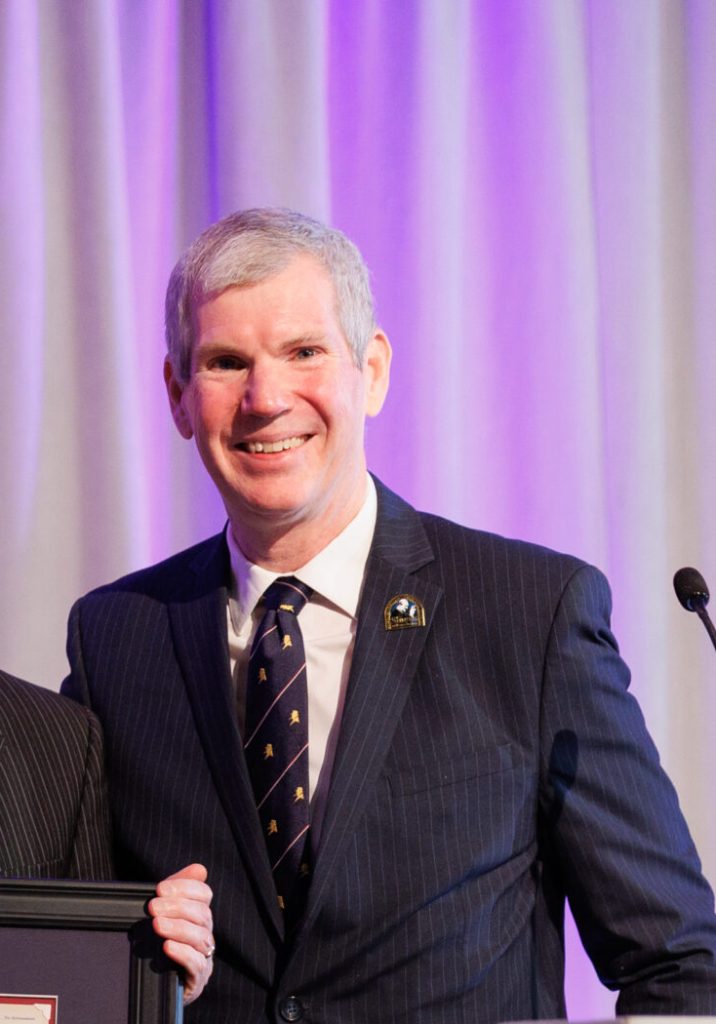
The Hottest Ticket in Town, 1946 By Donald P. Lofe, Jr. President and Chief Transformation Officer and Churchill Fellow, Westminster CollegeDirector, International Churchill Societ...
In fact, Churchill was more than ready for retirement. Only a year after his resignation, days before his eighty-second birthday, he finally admitted that he was not the man he was; he could not be Prime Minister now. Only a week after his last cabinet meeting, he and Clemmie went on holiday to Syracuse. Even though he was not the man he was, and despite his failing health, Churchill began his ‘retirement’ with some of his old vigour and energy. For an elderly man, he was remarkably resilient and determined. He embarked on holidays, painting tours and new writing projects. The first two volumes of his were published in 1956 and the remaining two volumes over the next two years; quite an achievement for a man in his eighties, even with the help of various historians and research assistants. As well as painting and writing, he devoted his energies to supporting causes that would improve Britain’s standing in the world. If he couldn’t do it through politics, he could do it through education. See Parliament's on Churchill's retirement, death and lying-in-state.
Churchill’s reputation as an orator is based principally on his speeches and broadcasts as Prime Minister during the summer of 1940 during a particularly vital point in the Second World War, when Britain was under the threat of invasion. You'll probably know lots of famous phrases or quotes from these speeches: ‘We shall fight on the beaches’, ‘This was their finest hour' and 'Never in the field of human conflict was so much owed by so many to so few’. His most well-known and most quoted speeches are those known usually as ‘Blood, toil, tears and sweat’ (13 May), ‘We Shall Fight on the Beaches’ (4 June) and ‘This was their Finest Hour’ (18 June), all of which were delivered in the House of Commons, though Churchill also broadcast the ‘Finest Hour’ speech over the BBC. He only made a total of five broadcasts to the nation during this vital stage of the Second World War (19 May, 17 June, 18 June, 14 July, 11 September), but these speeches conveyed Churchill’s determination and commitment, and they gave his country confidence. Did Winston's Words Win the War?
Churchill was now firmly established as a successful journalist and writer. He was commissioned, in 1903, to write a biography of his father, Lord Randolph, with an advance of £8000 – a very healthy sum. With remarkable speed, he produced two volumes and they were published in 1906. Most reviews were positive, admiring the style and Churchill’s unbiased approach but some weren’t impressed. Over the next few decades, he wrote another biography (of Marlborough, his illustrious ancestor, in four volumes), two volumes of autobiography () and three massive histories (, and ). (1908) a hunting expedition to east Africa in the autumn of 1907 turned into an enquiry into colonial affairs and resulted in a series of articles for the , which were later turned into his only travelogue (1908). (1923–31)Churchill’s memoirs covering the years 1911–1928. In October 1922, when Churchill was out of Parliament for the first time in twenty two years (apart from a few weeks in 1908), he took up writing again and embarked on his mammoth history of the First World War (and the pre- and post-war years), . It was published in 5 parts or volumes (in six books; confusingly, one ‘volume’ was spread over two books) over the years 1923 to 1931.
In the 1950s, Churchill devoted more and more time to reading the classics of literature. In 1953, he had been reading Trollope, the Brontes, Hardy and Scot, when he heard in October that he was to be awarded the Nobel Prize for Literature. This wasn’t, as some assume, for his work on (the final and sixth volume was to be published in November 1953)but in recognition of his life-long commitment to – and mastery of – the written and spoken word. He was disappointed that it was not the Peace Prize. He was in Bermuda when the prizes were to be presented by the King of Sweden in Stockholm – there was no question which event took precedence – and Clementine accepted the award on his behalf.
Churchill knew that the fastest way to political advancement lay in active service – ‘the glittering gateway to distinction’. He bemoaned the fact that the world was growing so ‘sensible and pacific’. There weren’t any battles close to home – as yet – so he had to look further afield to find action. For the moment, though, there was action to be found on a far-distant island – Cuba – and, through his mother’s contacts, Churchill managed to wangle a commission as a war correspondent for the Off he went, spirits high, to see some action. In late 1895, he and a friend Reginald Barnes were given leave to travel to Cuba, to observe the military campaign by the Spanish government troops against Cuban guerrilla rebels. Churchill spent some of his twenty first birthday under fire when the column he was travelling with was attacked. Despite only being in Cuba for sixteen days, he was recommended for the Spanish Cross of the Order of Military Merit.
Contrary to popular opinion (an opinion encouraged by Churchill himself in his autobiography,), he was actually quite good at some subjects at school. He was particularly good at English and history, both subjects in which he showed considerable promise. This early promise was borne out when he became a war correspondent, sending dispatches back to London from far-flung parts of the Empire for newspapers. He was determined to get himself noticed and to get himself into politics – and, for an adventurous, reckless young man on a mission, this seemed as good a way as any. Between 1897 and 1900, with the help of his mother’s lobbying, he fought in three of Queen Victoria’s wars while doubling up as a war correspondent. He quickly turned all three experiences into books. His literary career was off to a flying start.
See Churchill making his speech, and receiving a standing ovation from his audience, at County Hall here https://wwwyoutubecom/embed/cRBGfYVOELk copyright: British Pathé...
Dr Warren Dockter (University of Cambridge) and Professor Richard Toye (University of Exeter) discuss Winston Churchill’s war memoirs https://wwwyoutubecom/embed/b7-RrQGXehQ?list=PLVRJoyIOeaRK4eDDCZ_GOgIAXWOcRtmf- copyright: Dr Warren Dockter and Professor Richard Toye...
Dr Warren Dockter (University of Cambridge) and Professor Richard Toye (University of Exeter) discuss Winston Churchill’s career as a journalist for the Daily Telegraph https://wwwyoutubecom/embed/yKPGWfi5nII?list=PLVRJoyIOeaRK4eDDCZ_GOgIAXWOcRtmf- copyright: Dr Warren Dockter...
International Churchill Society the preeminent member organization dedicated to preserving the historic legacy of The Rt. Hon. Sir Winston Churchill.
Get the Churchill Bulletin delivered to your inbox once a month.
Join the International Churchill Society today! Membership starts at just $29/year.