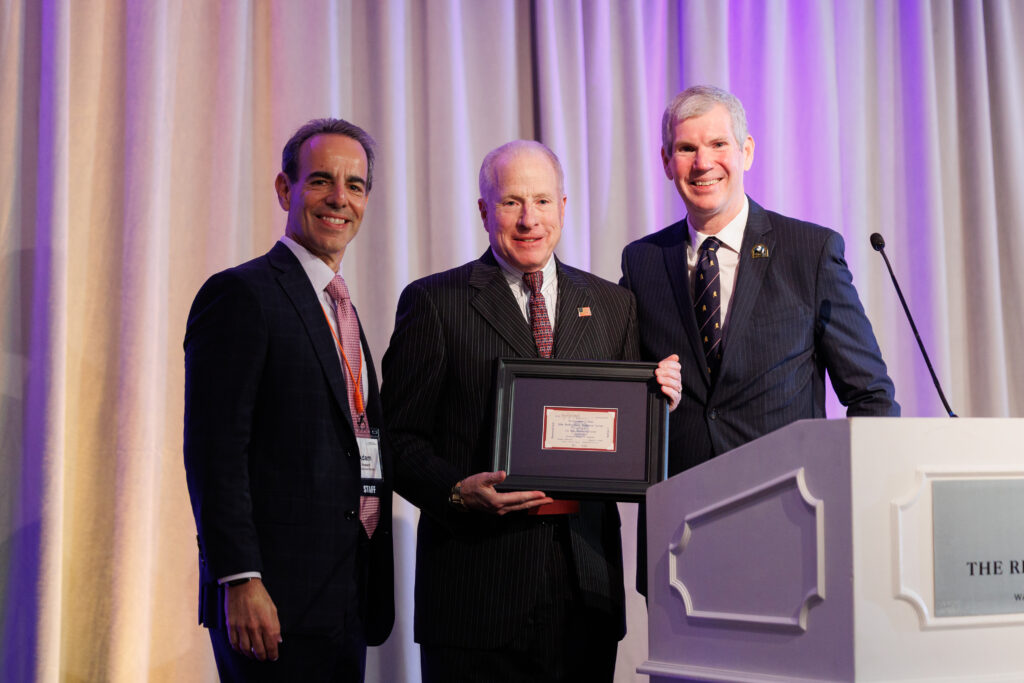
The Hottest Ticket in Town, 1946 By Donald P. Lofe, Jr. President and Chief Transformation Officer and Churchill Fellow, Westminster CollegeDirector, International Churchill Societ...
On 24 August, German night bombers aiming for the airfields accidentally destroyed several London homes, killing civilians. Churchill retaliated immediately by bombing Berlin the following night. Starting on 7 September 1940, London was bombed by the for 57 consecutive nights, and other British cities were targeted. But a real turning point in Britain’s fortunes in the war occurred on 15 September. In an attempt to shatter British morale, now that an invasion began to seem increasingly unrealistic, Hitler sent two enormous waves of German bombers. But their attacks were scattered by the RAF; the German defeat caused Hitler to order, two days later, the postponement of preparations for the invasion. In the face of mounting losses of men and aircraft, the switched from daylight to night-time bombing and although fighting continued in the air for several more weeks, and British cities continued to be bombed, German tactics to achieve air superiority ahead of an invasion had failed.
Hitler invaded Poland on 1 September 1939. Two days later, when their ultimatum expired, Britain and France declared war on Germany. Churchill was still mistrusted by many in his own party but the failings of the appeasement policy were so clear, and the swing in public opinion so great, that Prime Minister Neville Chamberlain had no choice but to appoint Churchill First Lord of the Admiralty, just as he’d been at the outbreak of the First World War. Nearly twenty five years after he had left the same post, devastated and at one of the lowest points of his career, Churchill had a pivotal role to play in another war. And this one was going to be a very different war for Churchill.
Churchill later gave an impromptu speech to a vast crowd from the balcony of the Ministry of Health at the lower end of Whitehall, telling the crowds, 'This is your victory!' to which they responded loudly: ‘No – it is yours!’ Later that evening, Churchill went out again on to the balcony to speak to the crowds. The last official event of VE Day was a broadcast to the nation by George VI at 9.00pm. Buckingham Palace was lit up by floodlights for the first time since the country had been forced into ‘blackout’ at the start of the War and two searchlights arced over St Paul’s Cathedral, which had withstood the German’s bombing, in a giant ‘V for Victory. In the early hours of 9 May, the celebratory lights were extinguished. The war against Japan was still to be won. Victory had been achieved at great cost – the lives of men, women and children; the destruction of homes and cities; the dislocation of peoples, exhaustion of finances and a weakened British economy. But Britain – led by Churchill, in his and Britain’s ‘finest hour’ – had achieved what it set out to do. Its people had dared and endured and seen victory, ‘in spite of terror’. They – and Churchill – had survived. And for one glorious day, VE Day, they could celebrate.
For much of the war, Churchill lived not at 10 Downing Street, the residence of the Prime Minister, but in ‘the Annexe’, a building nearby in Whitehall. Underneath this, were the Cabinet War Rooms (now a museum called the Churchill War Rooms) – a ‘bunker’ – where he and his government were protected from the worst the German bombers could rain down on London.
The Earl of Halifax, Foreign Secretary since 1938, turned the job of Prime Minister down. As Simon Schama says in his History of Britain BBC series, ‘Churchill had seen the face of battle; Halifax had only hunted foxes’. Churchill’s appointment was inevitable – and his time in the wilderness at an end. Just after six o’clock in the evening of 10 May, Churchill went to see King George VI at Buckingham Palace and became Prime Minister and Minister of Defence. ‘Winston’ was indeed ‘back’. Churchill owed his rehabilitation to no-one but himself – he had stood alone for years – and this made him seem all the more powerful and the man to lead Britain in ‘this hour’. It was to be his ‘finest hour’.
Churchill is perhaps now best remembered for his powerful speeches and broadcasts, particularly those delivered during the Second World War – ‘a series of speeches that rank with the greatest in British history’ (Simon Jenkins, in , 2011). He used his great skill with the written word, and his dedication to rehearsing its delivery, to influence a national and an international audience. His speeches were carefully crafted both to raise morale at home and to act as political and diplomatic weapons abroad, sending messages of defiance to the enemy and calls to arms to allies. Learn more about Churchill’s development as a speaker, in an exhibition showcasing relevant . And this review of the exhibition in the .
1940 was Britain’s first full year of war – and it was a time of enormous challenge as the country faced the very real threat of defeat . It was also Britain’s ‘finest hour’. The events of 1940 shaped the way the war was fought and helped to set Britain on the road to eventual victory – and only an extraordinary leader could guide the country through. Churchill found himself needing all his daring and endurance to face the task ahead.
Although he’d sought to delay it as long as he could, at last Churchill had to accept that the invasion of Europe from the French coast was going to take place. Britain had become the minor player in the Anglo-American partnership and Churchill had to face the fact that he no longer had the influence to prevent what he saw as an incredibly risky operation. His walk with ‘Destiny’ was now several paces behind the Americans.
Despite Churchill’s visits to Paris to stiffen French resolve, his attempts proved futile as the German blitzkrieg shattered the French resistance and drove the British Expeditionary Force back to the Channel ports. A pause in the German attacks between 27 May and 4 June allowed the evacuation of over three hundred thousand British and French troops from the beaches at Dunkirk – turning what was in reality a colossal military disaster into what came to be seen as a success; the saving of lives by the ‘little ships’ (fishing boats, pleasure craft, lifeboats) that ferried men to the destroyers waiting offshore. For more on Dunkirk, and a collection of personal accounts from some of those who took part in the mass evacuation, see the BBC’s Archive . Britain was now clearly in Hitler’s sights. Vulnerable, weakened by defeat on the beaches of France (and with much of its weaponry and ammunition left on French shores), and a long way from its empire and commonwealth allies, it faced the might of the German army and air force alone.
Get the Churchill Bulletin delivered to your inbox once a month.
Join the International Churchill Society today! Membership starts at just $29/year.