
Bulletin #215 - April 2026
Why Churchill Matters to a New Sailor
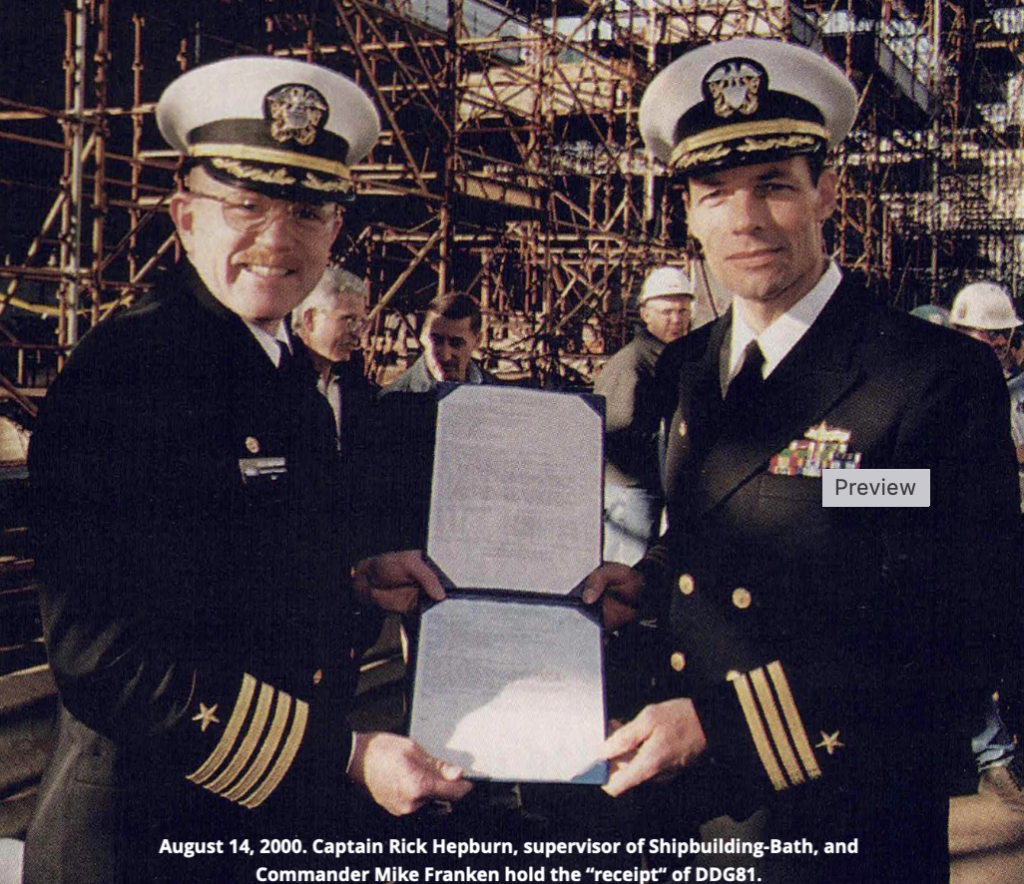
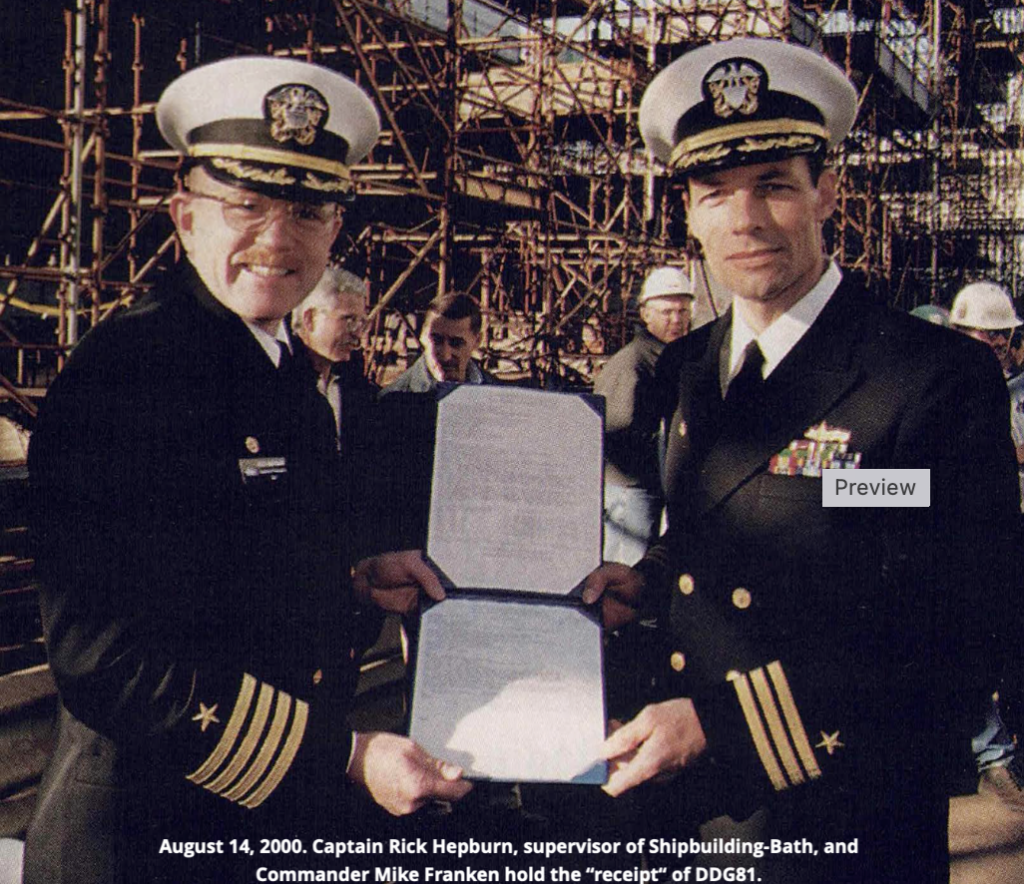
Captain Rick Hepburn, supervisor of Shipbuilding-Bath, and Commander Mike Franken hold the “receipt“ of DDG81.
April 20, 2026
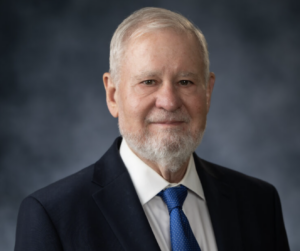
By Vice Admiral Michael Franken, U.S. Navy (Ret.)
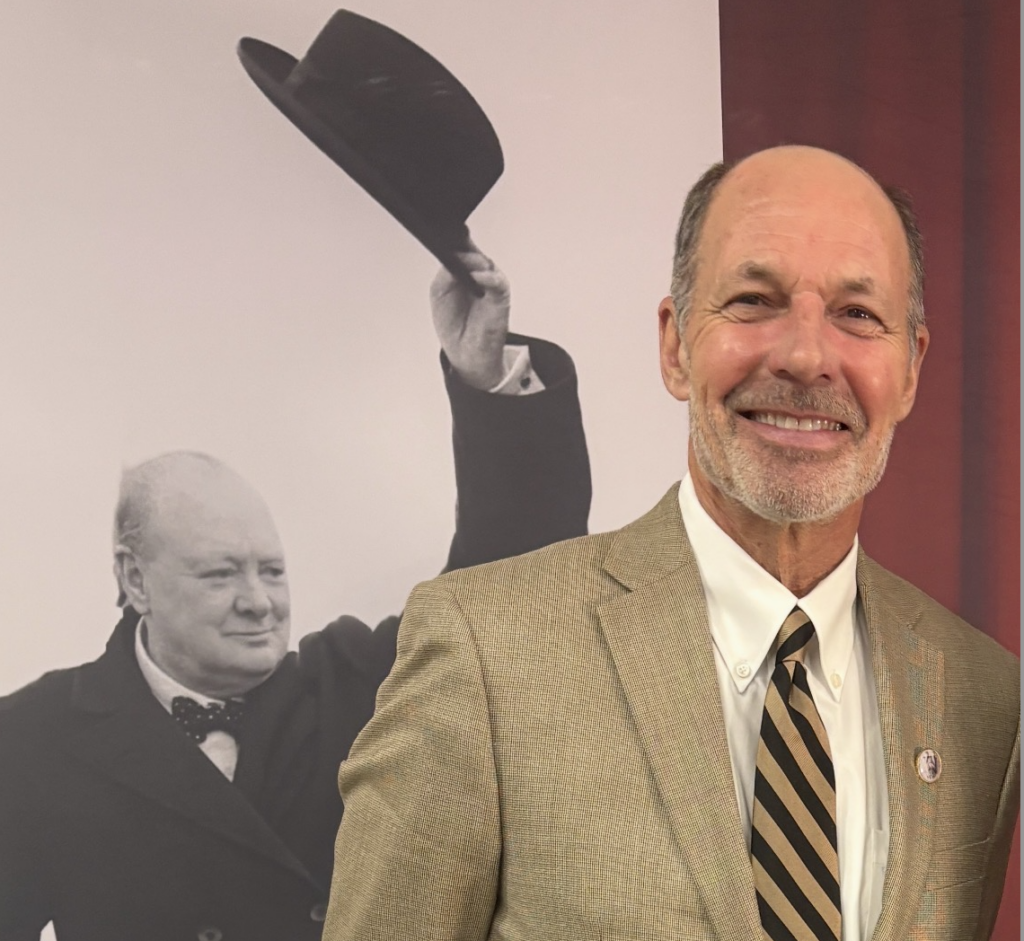
The call came one busy morning in the U.S. Senate at my cluttered desk. The voice on the other end said something about my being selected as the commissioning commanding officer of a ship named after Prime Minister Churchill. That got my attention immediately. After a long wait for command, I thought perhaps my turn had finally come. But no—the caller went on to explain that the ship’s hull number was eighty-one, DDG 81, which meant another two years to wait. That felt like an eternity to a guy itching to escape from the hectic pace of Washington, DC. Still, it was a good eternity, because there was a destination on the horizon.
At the time, I was serving as a Federal Executive Fellow for Senator Edward M. Kennedy, which added a layer of irony to the whole thing. Senator Kennedy was fond of Cuban Churchill-size cigars, which to some brought to mind the Bay of Pigs and his brother’s presidency. His father, of course, had a complicated and at times adversarial relationship with Winston Churchill. It all felt like a historical tangle of sorts. Yet what emerged from it was not contradiction, but celebration: Winston Churchill was finally getting his U.S. Navy namesake.
Word traveled quickly through the Russell Senate Office Building. After my boss, Senator Kennedy, came Senator McCain, then Senators John Warner, Joe Lieberman, Jeff Sessions, Dan Inouye, and many others. Nearly every one of them said the same thing: it was overdue. For a farm kid from Iowa, it was a powerful moment of realization. This was no ordinary command. It was a profound privilege, and it carried an unusual responsibility—to the crew first, then to the ship’s namesake, to the U.S. Navy, to the Churchill family, and, in an important way, to the Royal Navy as well.
I had not known that the Navy was planning to name an Arleigh Burke-class destroyer after Winston S Churchill—no period after the “S,” as I was quickly informed. Capitol Hill was a busy world, and I had been consumed with legislative work involving NASA, the farm bill, nuclear power, big Defense Department matters, and a host of other issues. Ship naming was the sort of Navy business that had drifted into the background. So the chance to return to the fleet was welcome enough. To return in command of Churchill was something else entirely.
The demands on a warship commanding officer are all-encompassing. Prior service at sea is the best preparation, and service on the same class of ship is especially valuable. Fortunately, I had served as executive officer under two outstanding commanding officers aboard USS Barry (DDG 52), Jim Stavridis and Kevin Quinn, both future Admirals. So Navy had prepared me well in the art and science of command at sea. Where I needed work was elsewhere: Churchill, the man.
Churchill’s ninety-five years of history—his political career, military service, speeches, letters, books, and sheer intellectual output—presented an enormous challenge. He wrote faster than most people could read. His followers, especially among the various Churchill associations, were not known for their patience with historical ignorance. I came to understand something quickly: it is not enough for a commanding officer to know the ship’s combat systems, propulsion plant, or even how to fight the ship. If you command a ship named for Winston Churchill, you had better know something about Winston Churchill.
I did not come to the job empty-handed. Like many naval officers, I had a technical education and had spent almost my entire career in guided missile destroyers. I had served under NATO command before. I knew World War II history reasonably well, not least because I was the son of a World War II veteran. Military service ran naturally in the family—my brother was still serving in the Navy, and at one point I had three brothers-in-law in uniform. We all understood, in a broad sense, that we were living in a world Churchill had helped shape.
But I did not yet grasp the full extent of Churchill the writer, Churchill the thinker, Churchill the craftsman of language and history. I had not really immersed myself in his work. In baseball terms, I was swinging behind the pitch.
That changed quickly.
One of the great gifts of commanding USS Winston S Churchill was the opportunity to come to know the Royal Navy and, through it, a wide array of remarkable British citizens. Most meaningful of all was my friendship with Lady Mary Soames. My first social outing with her began one dark morning at the Bath Iron Works shipyard and ended when my wife and I excused ourselves (after an eighteen-hour day) to retire for the evening while she was dancing with a former Secretary of Defense to 1940’s big band tunes. The moment remains vividly clear. Later, I spent an extraordinary weekend with her in London, hearing stories firsthand that will never appear in print, walking through the memories of her father’s life in a way no biography could fully capture. At one point I tripped over one of Churchill’s paintings leaning on the floor, and she casually said, “Just kick that out of your way.” I remember thinking, Probably not.
Her flat was a treasure house of history—paintings, papers, books, mementos, and the settled dust of a life that had touched the fate of nations. Every room seemed to hold some fragment of the twentieth century. Every moment there felt like something that ought to have been recorded. It was a very fast PhD in Churchillian history, and even more than that, in Churchill’s way of thinking. Mary Soames remains my favorite teacher.
That experience deepened my own understanding, but it also clarified something important: if Churchill’s name was going to mean something aboard that ship, then it had to be taught. Sailors do not arrive with a tutorial on their ship’s legacy. I remember asking a group of newly reporting sailors, as commanding officers often do, whether there was anything they wanted to know. One young sailor looked me squarely in the eye and asked, “Who is this Churchill guy?”
She was not joking. And judging by the faces around her, she had simply said aloud what others were wondering.
That moment stayed with me because it revealed the whole challenge. We cannot assume historical memory. We cannot assume that a famous name is also an understood one. In American education—public, private, or homeschooled—much depends on what gets taught, how well it gets taught, and whether anyone is listening when it is. Churchill was not necessarily a figure these sailors had studied in any depth. So if they were going to serve aboard a ship that bore his name, it became our responsibility to make that name real.
My tasker, make the Churchill persona becume part of the ship itself.
My great Executive Officer began placing a Churchill quote, or a small anecdote from his life, into the Plan of the Day. That may sound like a modest gesture, but it worked. Firstly, it humanized the man, his cadence, idiosyncrasies, breadth, and showed some mischievousness, which sailors love. We had no shortage of material, and it gave sailors regular contact with the man and his words. It also created a small but useful form of accountability. Senior enlisted leaders and officers would use those quotes to quiz junior sailors and make sure they were actually reading the Plan of the Day. In that way, Churchill entered the daily rhythm of life aboard ship. He became more than a name painted on the stern sheet.
And that matters.
A ship acquires character. A crew absorbs standards. Sailors internalize the tone, expectations, and identity of the command they serve in. On USS Winston S Churchill, the crew wanted to do well for the shipmate beside them. Unlike on many ships, we had very few disciplinary cases. Misbehavior was not seen merely as a violation of rules; it was seen as a failure of the team, an affront to the people who depended on you, and, in a sense, a slight against the good name of Winston Churchill. The namesake demanded more of us. And the crew wanted to rise to that demand.
There was also something powerful—something unusual—in the fact that the United States Navy had named a ship after a British statesman rather than an American. People would often ask whether this was the first U.S. Navy ship named for a foreigner. I would answer, “No. The Navy has had several ships named after foreign citizens. But this is the first named for an honorary American citizen.” To many, that sounded like a distinction without much difference. But to me, it underscored the point. This was no casual naming decision. The Department of the Navy and the Congress of the United States had chosen to honor Churchill because his leadership, courage, and service to freedom mattered not only to Britain, but to the wider alliance of free nations.
That was not lost on me, and I do not believe it was lost on the crew either.
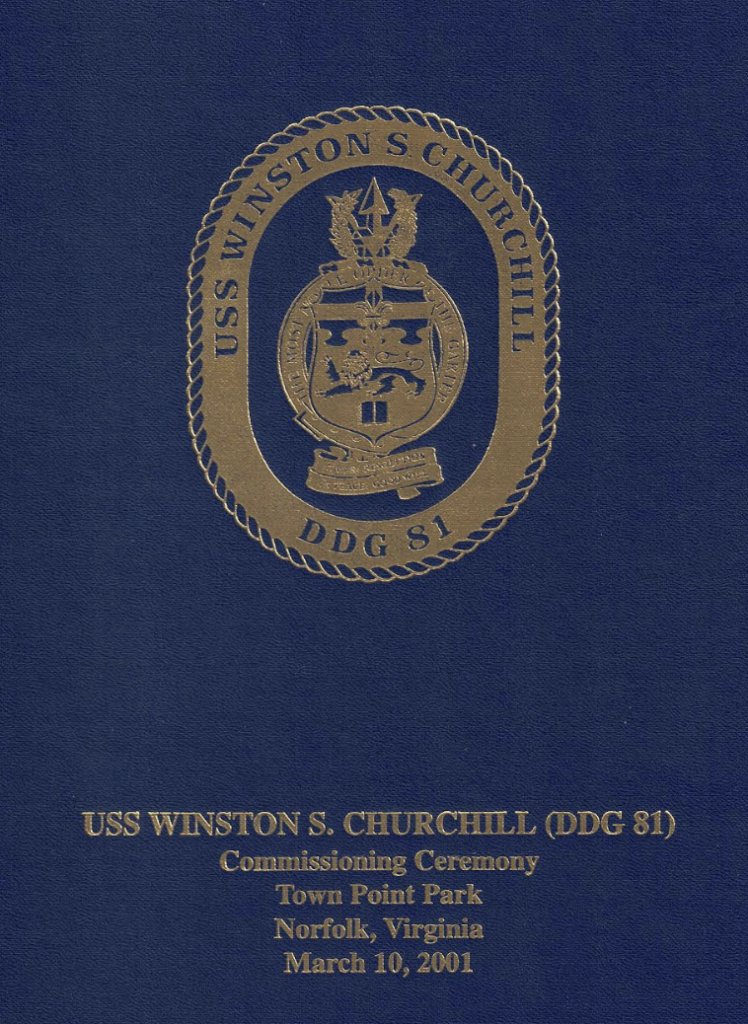
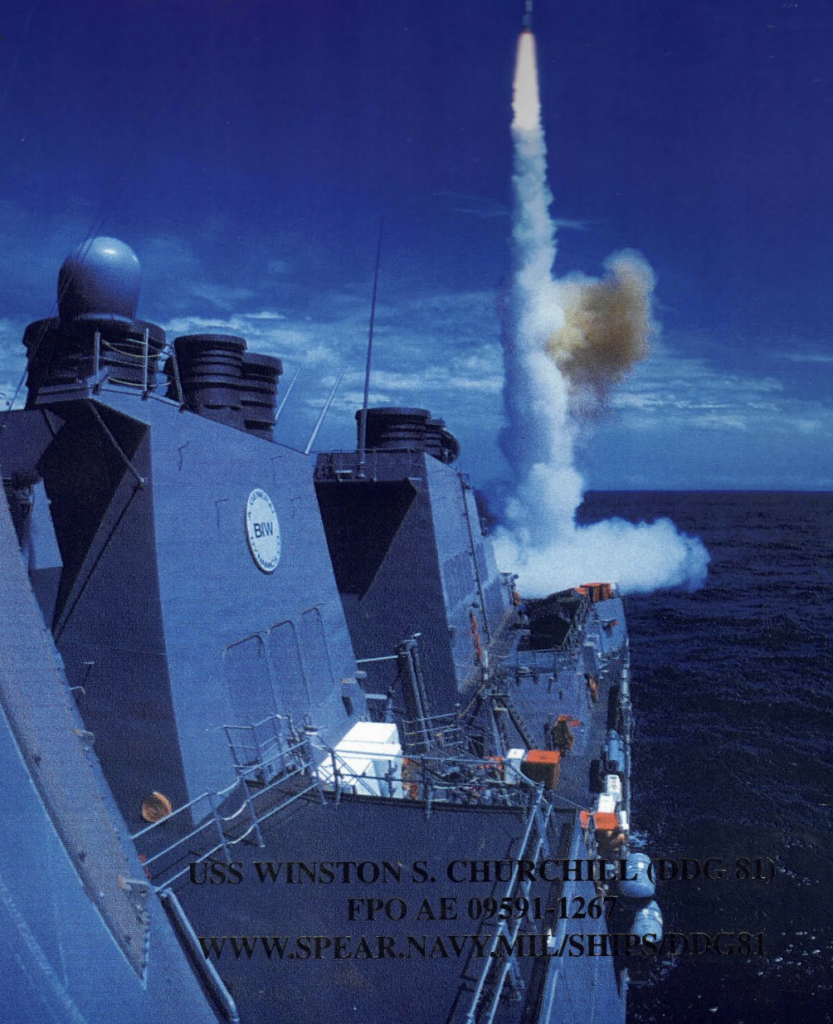
Once the ship was commissioned, I wanted her not simply to exist, but to begin acting like the ship she was meant to be. The Navy, to its credit, seemed to share that view. Our early schedule was relentless: helicopter wind-envelope testing, shock trials off Florida, weapons-system evaluations, inspections, certifications, and then the rare privilege of deploying alone and on our own timeline.
I will admit now that as we steamed out of Thimble Shoals Channel on that late summer day, bound east for workups with the Royal Navy’s Flag Officer Sea Training command, followed by port visits around the British Isles and weapons testing off Norway’s North Cape, I half expected the radio to crackle with a message telling me to turn around and come back. Not so fast, Franken. But the call never came. We kept going—into the sunrise, with a magnificent crew, with mechanical fluency, a stout warship, and a future that was still largely unknown. My thoughts went to a commanding officer’s words nearly twenty years before when he said to me, “Make the impossible look doable and the difficult look routine.”
That deployment had really begun two years earlier in our planning. This was a special ship being built in Bath, Maine, and I wanted us to think differently about what she could be. I believed the crew would be equal to an outsized challenge—even the idea of deploying a full year earlier than other newly commissioned ships. So the wardroom began piecing it together. The DDG 81 wardroom, the British Embassy in Washington, the First Sea Lord’s staff, a supportive fleet commander, a helpful commodore, and even the press all contributed in one way or another to the idea that this warship ought to undergo the best training the Royal Navy had to offer. I pushed where I could, fed the system some demand signals, and, with the backing of senior leaders, we got our opportunity.
That deployment allowed the ship to learn about itself in earnest. More than that, it gave the crew a deeper sense of why it mattered to serve aboard USS Winston S Churchill. It gave weight to the mission and context to the name. It connected the sailors to the alliance history embodied in Churchill himself. It turned the ship from a platform into something more than steel, systems, and procedures. It became a command with a story.
And there were moments that drove that home in unforgettable ways. I can still picture World War II veterans in ill-fitting uniforms, moving slowly and stiffly up the brow for the chance to kiss the deck of “their” ship. I saw it. And I had to turn away.
Our social events became opportunities for sailors to meet our hosts, dine with them, and make everlasting friends. There was no shortage of volunteers to serve at our swanky fantail parties. Rock stars, it seemed.
News of being a Churchill Sailor traveled fast. It was distinguishing. Remarkable. And in most cases, why Churchill mattered to a new sailor.
As our training intensified, sailors learned that like Churchill, they were developing resilience. The Man understood duty. He matters because he knew that leadership requires courage, but also study, discipline, language, and conviction. He matters because he understood alliance—not as sentiment, but as a serious commitment rooted in trust and shared purpose. He matters because he never stopped growing, never stopped writing, never stopped thinking, and never stopped serving.
That is not a bad standard for a young American sailor.
A sailor reporting aboard USS Winston S Churchill does not need to become a historian. But that sailor ought to understand the name on the ship. He or she should know that Winston Churchill was more than a wartime icon. He was a leader who bore immense burdens, spoke hard truths, inspired free people, and helped shape the modern world. If you serve on a ship named after him, you should know why.
That is not merely about honoring the past. It is about shaping the present.
For our crew, Churchill became part of how we understood ourselves. He gave us a benchmark. He gave us language. He gave us a standard larger than any one sailor and larger than any one captain.
That is why Churchill matters. And that is why teaching his legacy to a new sailor is not optional. It is part of taking command seriously. And it was a pleasure.



Subscribe
WANT MORE?
Get the Churchill Bulletin delivered to your inbox once a month.