Bulletin #215 - April 2026
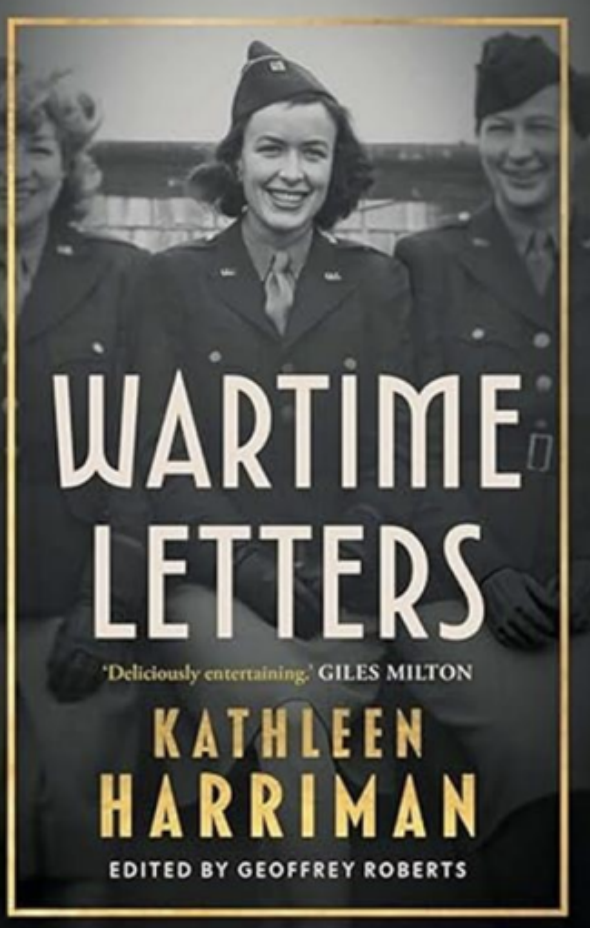
Wartime Letters of Kathleen Harriman
April 20, 2026
Edited by Geoffrey Roberts,
Pub. Yale University Press
Review by Cita Stelzer
Fortunately for historians, Kathleen Harriman, one of the more remarkable of the many remarkable women to stride across the world stage during World War 2, was a prolific letterwriter. Between her arrival in London on May 9, 1941, and early January 1946, Kathleen wrote regularly to her sister, Mary, her step-mother Marie (her father, Averell Harriman’s new wife), and her old Scottish nanny, and at times to her London roommate, Pamela Churchill (nee Digby), then still married to Randolph.
The letters, written from London, Moscow, the Yalta conference and many places in
between are so numerous that Geoffrey Roberts’ brilliantly edited and helpfully annotated version of those letter runs to over 400 pages. And what letters they are!
Kathleen Harriman was born into wealth and privilege, her father, Averell Harriman (mostly called Ave by her in her letters), a businessman, had inherited a railroad fortune and enhanced it with shrewd investments, and her maternal mother was wealthy in her own right. Available to her was a life of debutant balls and an agreeable marriage within her social class. The first step to such a life was Foxcroft, an elite Virginia girls’ boarding school, where she excelled at tennis, riding and skiing, the latter to a level that had her considered for the US Olympic team. Known as Kathy, her interest in and proficiency at skiing enabled her to serve as an effective hostess when her father later developed Sun Valley, the famous Idaho ski resort.
After Foxcroft she charted an unconventional path, choosing liberal-arts Bennington
College rather than one of the traditional ‘seven sister’ colleges. It was at Bennington, writes Roberts in his Introduction, that “she honed her intellect, broadened her horizons and developed her writing voice.” Her essays on international affairs and world politics, written as war became closer in the 1930s, attracted praise from, among others, her father. At age 24, she decided to join him when he was sent by President Roosevelt to London to manage the US’s Lend-Lease program.
Averell Harriman was to be the liaison between the American and British governments at
the start of the Second World War, before the Americans entered the war, but during the
period in which Franklin D. Roosevelt was doing all public opinion at home would permit to
aid Britain. His second wife remained at home, leaving Kathleen to serve as her father’s
part-time London hostess. But mostly she worked, first at Hearst’s wire service,
International News Service (INS) and later at Newsweek’s London bureau, filing dozens of
stories during wartime London – and she loved every minute of it.
Roberts has grouped her wartime letters into sections: first the letters from London (May
1941- 1943) and then the letters from Moscow (October 1943-1945). Interspersed in both
are letters from Yalta and other places in which Kathy found herself. These wartime letters
reveal a hugely intelligent, intensely curious young woman who was willing to work hard in
a man’s journalistic and military world, and who enjoyed the thrill of “scooping” competing
journalists. Even if they were one of the few female journalists working in London.
On the fateful night of Sunday 7 December ,1941, Prime Minister Winston Churchill had
organized a dinner at his country house, Chequers, Buckinghamshire, to celebrate Kathy’s
24th birthday. The guests suddenly heard on the 9 PM radio news that Japan had
attacked Pearl Harbour. The cake was quickly forgotten. In a letter to her sister, she writes
that then Churchill and the other guests went off to make phone calls, returned to watch a
movie for about an hour, (a staple of Churchill dinners), and then returned to the salon to
hear the latest news that Japan had declared war on the British Empire and the US. “The
first day of war is always exciting”, Kathy concluded in her December 8, 1941, letter to her
sister, written from Chequers.
In Moscow, all her work was as an unpaid volunteer. “Pretty much everything I do these
days is novelty in one way or another, I’m enjoying it muchly (sic)”, she wrote. She ran the
British Embassy for her father as his official hostess and learned Russian so she could
speak to Soviet politicians and ordinary Russians. Doubly busy in Moscow, she had two
additional jobs: working for the Office of War Information preparing a weekly summary of
all the war news reported in The New York Times for circulation to the foreign diplomatic
community, and arranging for a glossy magazine in Russian titled Amerika, designed to
show the Soviets how good life in the United States was. It didn’t work: people feared
being seen by the ever-present Soviet surveillance teams reading an American
publication.
She worked hard to ease the tensions between her father, the Ambassador, and the State
Department employees, who were old Soviet hands. Kathy included Embassy staff,
enlisted men and officers plus the Soviets and other diplomats stationed in Moscow, in
dozens of daily lunches, tea parties, and dinners at the embassy. She even made thearrangements necessary for Lillian Hellman, an American left-leaning playwright, to spend
time at the embassy, recuperating from some ailment.
There are many personal titbits in these letters about her need for silk stockings for herself
and as gifts to girlfriends; packages ‘from home’ are essential, lipstick, mascara and
underwear. At the same time, she sympathizes with the British and Russians lack of
clothing, especially coats and boots which she also needs her friends in the US to send to
her.
She was sensitive to the human suffering with which she was surrounded when out and
about hunting for stories – rationing and the blitz in London, shortages and the People’s
Commissariat for Internal Affairs, abbreviated as NKVD, that was the interior ministry and
secret police of the Soviet Union from 1934 to 1946. She pushed hard to get stories about
that suffering out to her American readers. For example, in London she interviewed young
men who had escaped from Belgium looking to write their stories, she interviewed women
in factories and wrote describing their work, and their eagerness to get out of dreary work
in the home, to which many would never return once the war ended. She visited hospitals
and bomb sites, managing to maintain her optimism and humour throughout.
What comes across most vividly is the personality of this intrepid young American woman
in two very different foreign wartime cities with contrasting political systems. She is
endlessly grateful for the chance to work and be at the centre of the world, with news
breaking all around her. In London, she wrote “Did I tell you – overworked as I am – I love
my work?”
Her hard work, talent and social skills, and her father’s powerful positions, enabled her to
know everyone of importance from Prime Minister Winston Churchill to every top British
and American general. She interviewed many enlisted men. And with all that, she
managed a very active social life centred on her new British friends – many of whom
became the source for information she could use in her work, or for stories in the America
press, always careful of the censors.
Her thumbnail descriptions of the great and not-so- great men, it was mostly men, make
for delightful and informative reading, and their candour prompted her to warn her sister
Mary, while sharing a dim view of US Ambassador to the Court of St. James, John G.
Winant, “Please be discreet in your parcelling out of my indiscretions…” . This warning
applied most specially to her views of Randolph Churchill, then married to her friend
Pamela. Randolph, she wrote, has an “amazing lack of human understanding. … The P.M.
wants him to take a big part in Parliament, the prospects of which are terrifying.” Almost 30
years after Kathleen penned these words, Pamela became Mrs. Averell Harriman.
General George Marshall is “full of fun with great dignity”. “The love of my life, Major
General Sir Hastings Ismay (you must admit that’s a wonderful name) … a thoroughly
charming man, and after all one can’t be blessed with all the graces.” known to all as Pug.
Lavrenti Beria, “Head of the NKVD, a role which makes him the most feared man. He is
little and fat with thick lenses which gives him a sinister look – but quite genial.” On FDR,
at a small, private dinner at Yalta, “He’s really absolutely sweet – very easy to make
conversation to – amusing and generally in great form.”
Stalin at a dinner at the Yalta Conference, reported Kathy, rose from the banquet table,
approached to clink glasses with her, “a very nice gesture” she reported. Her father had
warned her to be ready to offer a toast, which she did in her best Russian. Stalin would
give her a Russian thoroughbred stallion named Boston as a farewell gift.
Kathy describes her view of Churchill in Downing Street, “The P.M. is much smaller than I
expected and a lot less fat … and looks rather kindly like a blue teddy bear” in his RAF-
blue one-piece siren suit … very gracious … has a wonderful smile”.
On 11 February 1943, Kathy went to the House of Commons to hear the Prime Minister
report on, inter alia, the Casablanca Conference with Roosevelt to plan the next campaign
in the war, the Adana meetings at which he tried to persuade Turkey to join the allies, as
well as progress in the war. Kathy noted sourly, “his announcement of Ike’s appointmentas Commander-in-Chief went ungreeted by even one “Hear, Hear” from the Prime
Minister’s fellow ‘honourable gentlemen’.”
It would not be surprising that she used her attractive American youthfulness and intellect
to, shall we say, flirt with ‘bigwigs’ and even sometimes with ‘littlewigs”, but she got her
stories, filed on time, sometimes ahead of the other reporters, even finding time to sun
herself in the Downing Street garden.
There was one contact that led to more than a little flirtation, enough more than that for
her to report it to Pamela. She had played tennis with General Ira Eaker, who she
described as “a very nice man and top of my list of those who should be ‘cultivated’ ”.
They had met again in Caserta, Italy, at Ike’s Italian headquarters. The sequence of
events is not clear from her letter to Pamela, but at one point the General sent her a
diamond, ruby and sapphire ring, which she had previously turned down while they were
both in Caserta. The record is not clear on whether she kept it or not. As I pointed out
before, this is the sort of intimate tit-bit Kathy typically shared with Pamela Churchill.
Pamela was a particularly close friend with whom she shared a London flat and a country
cottage, even though she knew that Pamela was having an affair with her father, who was
not then married to Kathy’s natural mother. She did not, however, share the rather dim
view of Pamela’s husband, Randolph, who created the usual problems at the cottage as
he did everywhere. Many decades later, after Ave, whom Pamela had married, died,
Kathy’s friendship with Pamela would end in anger and lawsuits.
Historians owe an enormous debt of gratitude to David Mortimer, Kathy’s eldest son, after
she had married Stanley Mortimer, and David’s wife, Shelley Wagner, for granting
Geoffrey Roberts access to the letters of one of the most extraordinary women, no, one of
the most extraordinary people to become involved in the effort to defeat Germany during
the Second World War.
Readers were introduced to Kathy in two biographies of her father, Averell Harriman, and
she is mentioned in books about the Yalta Conference, but there is neither an
autobiography nor a full-scale biography of her available. These letters do much to fill the
gap in our knowledge not only of the woman but of the wartime in which she lived.
As these letters show, Kathy Harriman was an astute observer of the war and its
participants. And gosh! The lady is a hellova writer too – to paraphrase her lively 1940s
jargon.
Cita Stelzer received a BA degree from Barnard College, with a major in history. She is an Advisor of the International Churchill Society, a former member of the Churchill Archives Centre US Advisory board, President of the Arizona chapter of the International Churchill Society, and a former Trustee of Wigmore Hall. Cita is also a Churchill Fellow of the National Churchill Museum in Fulton, Missouri. Her first book, Dinner with Churchill: Policy-Making at the Dinner Table, was published, 2013. Her second
book, Working with Winston: The Unsung Women Behind Britain’s Greatest Statesman, was published, 2019. Her third book is Churchill’s American Network: Forging the Special Relationship, out now. Cita is currently writing a fourth book on Winston Churchill.



Subscribe
WANT MORE?
Get the Churchill Bulletin delivered to your inbox once a month.