
Bulletin #214 - March 2026
Why Churchill Matters
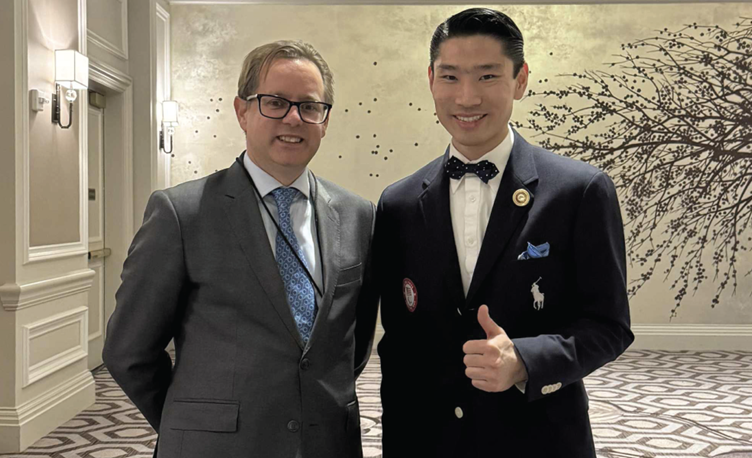
The author with ICS board member Jack Churchill at the 2025 Churchill Conference; Image: ICS
March 18, 2026
My Ever-changing Churchill
By Yan Xiao Gong, American Paralympic sharpshooter representing Team USA.
Growing up in a military family as a boy in Shanghai, I was surrounded by binoculars, maps, protractors, bulky radios, propaganda films from the 1950s, and belts and buckles in wax paper. I was dead certain that my life’s script called for becoming an army commander like my grandfather. To a starry-eyed child who aspired to be another Winston Churchill, George Patton, or General Peng Dehuai, the decorations, the medals, and the chance to carry a nickelplated sidearm at all times were more than enough to make me look forward to adulthood.
I was transfixed by the stories of my grandparents and their colleagues about the twentiethcentury events through which they had lived and the anecdotes that illustrated their views. My favorites were those involving the times that they spent in the May Seventh Cadre School, a “reeducation” facility established for former military officers of the People’s Liberation Army during the Cultural Revolution in the 1960s and 1970s. Typically, men were sent to these labor camps by the Communist government they had once served due to class disparities, “blasphemies” expressed about Mao Zedong, defending convicted comrades, or sympathizing with “decadent capitalist ideologies.” Naturally, as a child in the early twenty-first century, I found stories about being forced to sleep in cowsheds and pigsties, narrowly surviving executions, and enduring “struggle sessions” to be gripping stuff!
A man of proven stamina, my grandfather steered me toward Churchill, extolling his convictions and moral fortitude during Britain’s darkest hour. My grandfather insisted that the great British leader had actually saved humanity, a belief that contradicted the official school materials provided to me and other children in the People’s Republic of China. Perhaps embracing my grandfather’s view satisfied my natural contrariness. Even before Grandpa shared his feelings with me, however, I was captivated by the dashing image of Churchill depicted in the 1972 film Young Winston—an epic which, when I was still in kindergarten and elementary school, I inflicted on my family and friends through endless showings. To their credit, they feigned enthusiasm like Oscarworthy thespians. For me the movie provided an adrenaline rush. I loved Churchill’s Zeliglike knack for inserting himself into history’s hotspots and the fact that he carried a Mauser “broomhandle” pistol, my favorite!
“He made a good deal of great and petty blunders, but he always bounced back and learned from all of them,” my grandfather liked to tell me about Churchill, while also praising giants like Margaret Thatcher and Frederick von Hayek and highlighting especially their human virtues. Later, in elementary school, when I started braving the world of books without pictures, I plunged deeper into the life of the figure whom I most idolized. The more I learned about Churchill, the more I swelled with a quirky pride. “What would Winnie do about today’s challenges?” I wondered. “He wouldn’t pussyfoot for one thing,” I concluded, “but he also made it all look so breezy!” Growing up, I always excelled at individual sports that intrigued me. Like Churchill, “I could learn quickly the things that matter.” For me that meant skiing, scuba diving, shooting, horseback riding, and fencing. As a teenager cramming for adulthood, weekends were my opportunity to channel Churchill’s swashbuckling style in whatever ways I could. Having too much confidence in oneself is one thing, but suffering a rare spinal cord injury while surfing is another. The odds of it happening—my case is one of only thirty-four ever recorded globally—were negligible, so I had no reason to regret my behavior, nor to let the experience cloud my future judgments (though my parents would vehemently disagree). Following my injury in high school, visions of military glory after attending West Point faded away, as the severity of my condition sank into my consciousness. Another of my heroes, General Patton, had suffered a severe spinal injury too, but it came at the end of his life, after he had attained great fame in battle. “Why now for me?” I wondered.
In answer, I resolved to focus on therapy and gym training, knowing that mobility gains I made in the first few years of recovery would determine my abilities for the rest of my life. For years, my family chauffeured me through a grueling, eightymile odyssey every day involving rehab sessions in outpatient clinics, traditional Chinese medicine, gym, school, and home. The real agony for me was not the struggle to overcome the civil war between my rebellious muscles and nerves but knowing that I was burning through precious youth—if not a large chunk of life—just to ape the casual feats most people perform without a thought. Yet this period was not without reward: I have never been closer with my parents nor had more time with my books. I formed cherished memories that now help to sustain me while I compete internationally.
During my rehab grind, I binged on all things Churchillian: documentaries, newsreels, and nuggets from the works of Sir Martin Gilbert and Andrew Roberts. Only later did I discover Lord Roberts’ Walking with Destiny, which became my pocket gospel. This premier Churchill biography in one volume I could lug around through all my excruciating and soul-sucking endurance tests. “What would Churchill do?” I now wondered. No longer did I think of my hero as “Winnie” the way I did as a child. I started to understand and connect with Churchill the man more calmly. I thought less about the medals, cigars, V signs, and the thrill of Omdurman and more about the extraordinary sense of his moral convictions and composure during his wilderness years and the darkest hours of the war.
Without Churchill’s example and the values which I was fortunate to have instilled by my family, I seriously doubt that I would have mustered the strength to endure my injury or the composure necessary for my Paralympic endeavors. When I finally entered into the “real world” after having long been cared for by others, I had the knowledge of Churchill’s strength and moral compass to guide me. Churchill loved war and feared war; he was loud and ostentatious, but had enormous empathy; born an aristocrat, he extolled all humanity; he introduced the welfare state, yet he preserved the free market; he was the greatest of statesmen, but never a mere political animal; he made blunders, but remained steadfast when the world was crumbling; he switched parties twice, yet remained true to his convictions. If there is one supreme quality that stands out for me in Winston Churchill, it is his magnanimity exercised through strength and good sense. Thank you, Sir Winston.
This article was featured in the recent issue of The Finest Hour. Subscribe here.





Subscribe
WANT MORE?
Get the Churchill Bulletin delivered to your inbox once a month.