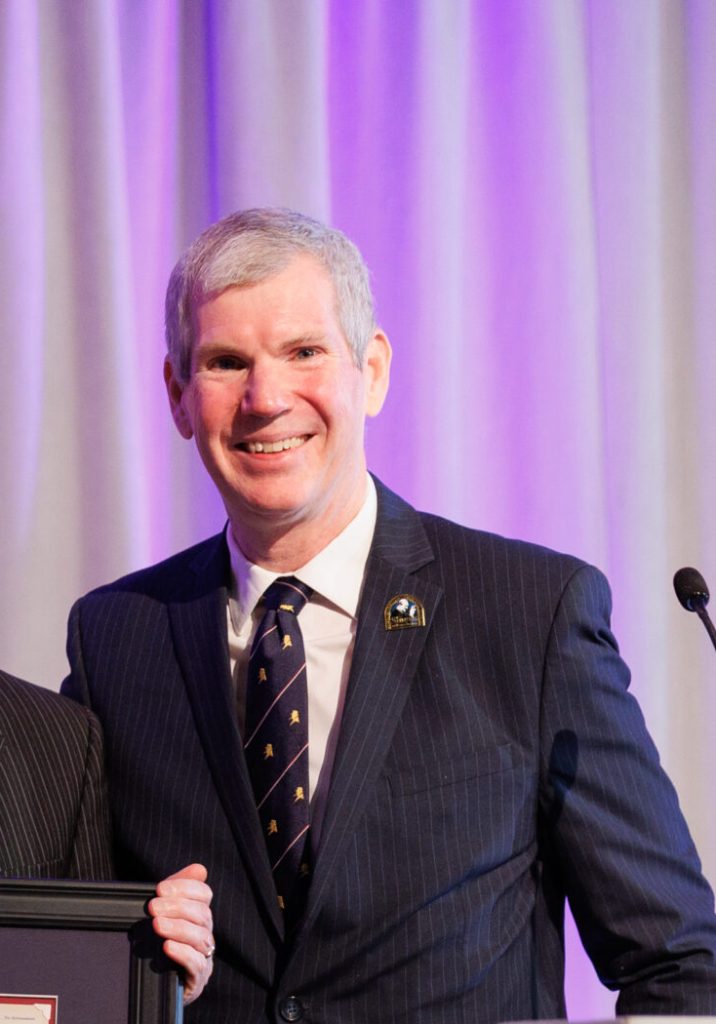
The Hottest Ticket in Town, 1946 By Donald P. Lofe, Jr. President and Chief Transformation Officer and Churchill Fellow, Westminster CollegeDirector, International Churchill Societ...
copyright: Churchill Archives...
In November 1945, Churchill was invited to give one of a series of annual lectures at Westminster College, Fulton, Missouri. The letter of invitation was annotated by President Truman who offered to introduce Churchill, and therefore guaranteed a high profile event. Churchill’s speech, given on 5 March 1946, was to prove enormously influential. Originally entitled ‘The Sinews of Peace’, it became better known as the ‘Iron Curtain’ speech because of his use of a phrase now in common use. This was Churchill’s first public declaration of the Cold War, in which he warned the western world about the ‘iron curtain’that was descending over Europe, drawn down by the Russians, and called for greater Anglo-US cooperation, in what he called a ‘special relationship’, in the battle against Soviet expansionism. Click to see Churchill give this speech in the presence of US President Harry S. Truman. The speech drew the world's attention to the threat of a powerful Soviet Union and the potential ‘cold war’ between the East and the West. Although the ‘iron curtain’ phrase had been used before, Churchill gave it common currency and in so doing, increased awareness and influenced world policy. Some Russian historians have even dated the beginning of the Cold War from this speech. Read more about Churchill and his role in the Cold War .
Friday 8 May 2015 was the anniversary of VE Day (Victory in Europe Day), marking seventy years since the end of the Second World War in Europe. The occasion was commemorated with a three-day weekend of remembrance and celebration, with events being held across the UK.
Churchill’s speech-making didn’t always go well. Even great speakers ‘dry up’. Although he had a phenomenal memory (he’d won a prize at school for reciting great reams of poetry), learning speeches by heart clearly wasn’t enough. Even though he meticulously rehearsed them beforehand, there was always the possibility of forgetting his lines. In the spring of 1904, making a speech in the House of Commons, he’d been speaking for forty-five minutes when – without notes to hand – he forgot his words. He struggled for ‘the most embarrassing 3 minutes of my life’, trying to remember the rest of his speech, and then sat down in silence, humiliated. So even great speakers can find public speaking difficult and stressful. After this confidence-shattering experience, Churchill nearly always prepared full notes – and had them to hand – to prevent this happening again. And thanks to this, the Churchill Archives Centre contains lots of Churchill’s speeches notes. (No wonder ‘presentation skills’ experts encourage the use of those small cards with speaking notes or handy PowerPoint slides as prompts...)
Churchill is perhaps now best remembered for his powerful speeches and broadcasts, particularly those delivered during the Second World War – ‘a series of speeches that rank with the greatest in British history’ (Simon Jenkins, in , 2011). He used his great skill with the written word, and his dedication to rehearsing its delivery, to influence a national and an international audience. His speeches were carefully crafted both to raise morale at home and to act as political and diplomatic weapons abroad, sending messages of defiance to the enemy and calls to arms to allies. Learn more about Churchill’s development as a speaker, in an exhibition showcasing relevant . And this review of the exhibition in the .
Watch newsreel footage of the Conference, with some of Churchill’s speech, here Churchill stops his speech to take a drink and then says: ‘I don’t often do that’ After laughter and...
Never give in, never give in, never, never, never, never – in nothing, great or small, large or petty – never give in except to convictions of honour and good sense.
Finest Hour 173, Summer 2016 Page 50 Seventy years ago at Zurich University Winston Churchill delivered one of his most important post-war speeches (see pages 7, 31, and 41) Although given the...
The Scaffolding of Rhetoric was written by Churchill in November 1897 Winston Churchill studied the art of speech making from a very early age This article was never formally published during Churchill’s...
Get the Churchill Bulletin delivered to your inbox once a month.
Δ
Join the International Churchill Society today! Membership starts at just $29/year.