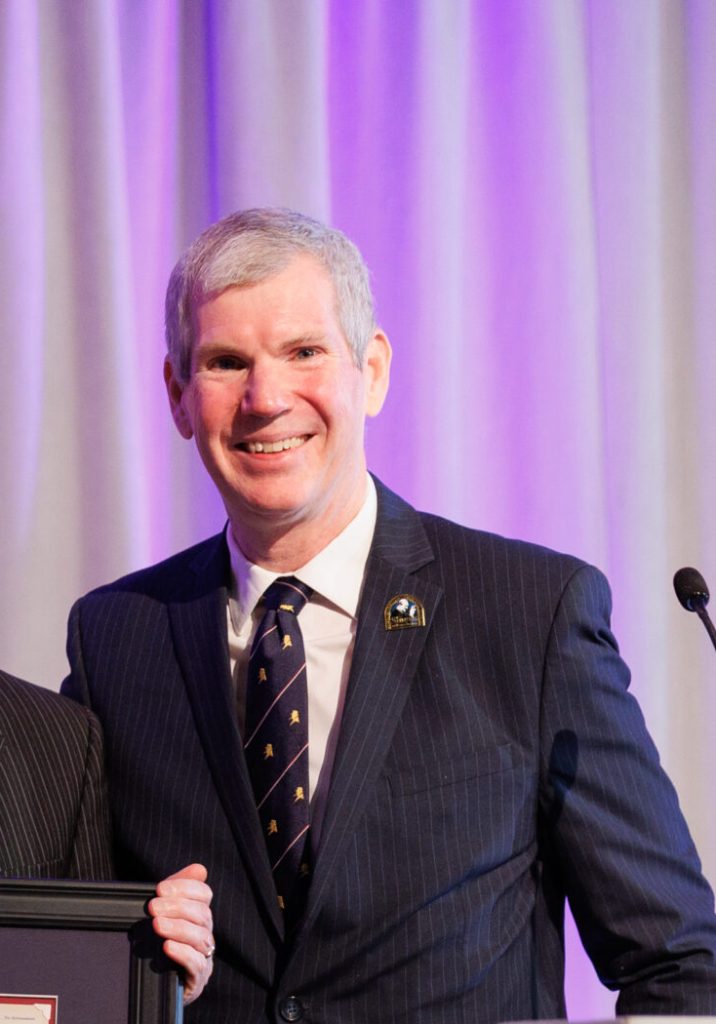
The Hottest Ticket in Town, 1946 By Donald P. Lofe, Jr. President and Chief Transformation Officer and Churchill Fellow, Westminster CollegeDirector, International Churchill Societ...
Finest Hour 192, Second Quarter 2021 Page 34 By Gerald R Ford The International Churchill...
80th Anniversary of Harrow School Speech Winston Churchill delivered one of his most famous speeches of the Second World War eighty years ago this month...
On 18 June, Churchill warned the British people that the ‘battle of France’ was over and the ‘battle of Britain’ was about to begin. His words were proved right. As early summer gave way to July and August, the threat of invasion loomed over Britain. Churchill, seeing that control of the skies was vital, put businessman Lord Beaverbrook in charge of Aircraft Production (as Minister) and encouraged British scientists to improve radar defences and counter German technology. In August, the Royal Air Force managed to inflict heavy casualties on the German and, in September, the German pilots transferred their attention from the coastal airfields and those in south-west England to London, allowing the fighter bases respite from attack but putting British people in the city at much greater risk. In early September a massive series of raids involving nearly four hundred German bombers and more than six hundred fighters targeted docks in London’s East End almost continuously, day and night. Listen to a reporter describing London in the Blitz, with St Paul’s Cathedral, its dome silhouetted against the ‘ruddy sky … almost like the Day of Judgement’. For more on the Battle of Britain, see the BBC collection in their online Archive of programmes and documents (including interviews from some of the battle’s heroes and film footage of the Spitfire and Hawker Hurricane fighter planes in action), . The turning point in Britain’s fortunes in the war was captured by Churchill’s famous speech in praise of the British men of the under-resourced Royal Air Force. But more was still to come.
We shall fight on the beaches, we shall fight on the landing grounds, we shall fight in the fields and in the streets, we shall fight in the hills, we shall never surrender.
Churchill’s first public speech was an impromptu one, when – in his last term at Sandhurst and on a visit to the Empire Theatre in Leicester Square – he called for makeshift barriers between the sexes, erected to prevent prostitutes from mingling with theatre-goers in the bar, to be pulled down (an unlikely cause for a nineteen-year old young man): ‘Ladies of the Empire, I stand for Liberty!’.
Churchill’s reputation as an orator is based principally on his speeches and broadcasts as Prime Minister during the summer of 1940 during a particularly vital point in the Second World War, when Britain was under the threat of invasion. You'll probably know lots of famous phrases or quotes from these speeches: ‘We shall fight on the beaches’, ‘This was their finest hour' and 'Never in the field of human conflict was so much owed by so many to so few’. His most well-known and most quoted speeches are those known usually as ‘Blood, toil, tears and sweat’ (13 May), ‘We Shall Fight on the Beaches’ (4 June) and ‘This was their Finest Hour’ (18 June), all of which were delivered in the House of Commons, though Churchill also broadcast the ‘Finest Hour’ speech over the BBC. He only made a total of five broadcasts to the nation during this vital stage of the Second World War (19 May, 17 June, 18 June, 14 July, 11 September), but these speeches conveyed Churchill’s determination and commitment, and they gave his country confidence. Did Winston's Words Win the War?
Churchill drafted his speeches several times and wrote them out in a way that would help him deliver them effectively. He rehearsed passages again and again, pacing his rooms, repeating them out loud, learning whole speeches by heart. He developed a unique oratorical style that both covered up and employed his speech difficulties so that his ‘lisp’ – or ‘stammer’, which could occasionally seem like a groping for words – became a prop, not a hindrance. Until old age, Churchill wrote every speech himself, usually by dictating to a secretary and then revising on the typed copy. He would then ask them to present the words on the page in ‘speech form’, in the style of a poem, with staggered lines and breaks in the text (referred to by others as ‘psalm style’), so that he could see at a glance where to pause, hesitate or add emphasis, when delivering the lines. He was a relentless reviser of his speeches – as he was with his books, too – and made numerous drafts. The final version would be retyped on smaller sheets, the size of notepaper, and even these would show last-minute changes to the text, with crossings-out and added scribbled words.
Churchill had a great gift with words. His speeches clearly demonstrate that. But he was also a prolific writer of books and articles; in his lifetime, he published more than forty books in sixty volumes, as well as hundreds of articles. The total now stands at fifty one individual works (eleven posthumous) in eighty volumes (twenty one posthumous). During his lifetime, he was a celebrated – and very well-paid – journalist and a very successful author. In 1953 he was awarded the Nobel Prize for Literature for his contribution to the written and spoken word. How did someone who purportedly wasn’t much of a student at school, manage to become so well known, so widely read and so highly regarded as a writer? For 'trivia' about Churchill’s literary life, see the Churchill Centre site . For a full list of all Churchill’s books, and a brief description of each, see the same site . A comprehensive selection of Churchill’s books – first editions, quality second-hand – as well as books about Churchill, visit , the independent bookstore in New York, the only physical bookshop devoted to his writings.
Out of office in the 1930s, Churchill’s could spend more time travelling and writing. Much of the former was for pleasure but he knew he could make money out of writing and he took every opportunity to turn his travels into much-needed cash. Despite being born in a palace, an independent financial base was essential (MPs only got a tiny salary in those days) and he needed funds to ensure he could live in the manner to which he’d become accustomed. He also had a growing family to support and a rundown house, Chartwell, to restore.
Get the Churchill Bulletin delivered to your inbox once a month.
Δ
Join the International Churchill Society today! Membership starts at just $29/year.