
Uncategorized
Event Opportunity: Churchill’s London & The Wallace Collection
March 27, 2026
Art, Memory, and the Private Man Behind the Statesman
London
June 18-21, 2026
Winston Churchill is remembered as a war leader. He should also be understood as an artist, a strategist, and a man who understood both solitude and command.
In London and at Chartwell, in quiet studios and underground war rooms, Churchill shaped both canvas and history. The International Churchill Society invites you to join us in London for an intimate, thoughtfully curated experience centered on the Wallace Collection’s exhibition: Winston Churchill: The Painter. The program includes a private engagement with a museum curator, a guided visit to Chartwell, and a concluding immersion in the Churchill War Rooms—the subterranean nerve center of Britain’s wartime survival.
This experience supports the International Churchill Society’s mission to preserve and interpret Churchill’s leadership and legacy at the highest level.
Event Overview & Opportunity
June 18 – London: Arrival
June 19 – Wallace Collection
- Curator led private group visit to the Churchill painting exhibition
- Evening private dinner with ICS leadership and special guests.
June 20 – Chartwell, Kent
- Transportation from London
- Guided exploration of Churchill’s home and painting studio
- Conversation and lunch on family legacy and preservation
June 21– Imperial War Museum and the Churchill War Rooms
- Tea with special guest
- Private guided immersion in the Cabinet War Rooms
- Examination of the preserved underground command center
Cost: $8,000 donation ($12,000 for couples) inclu
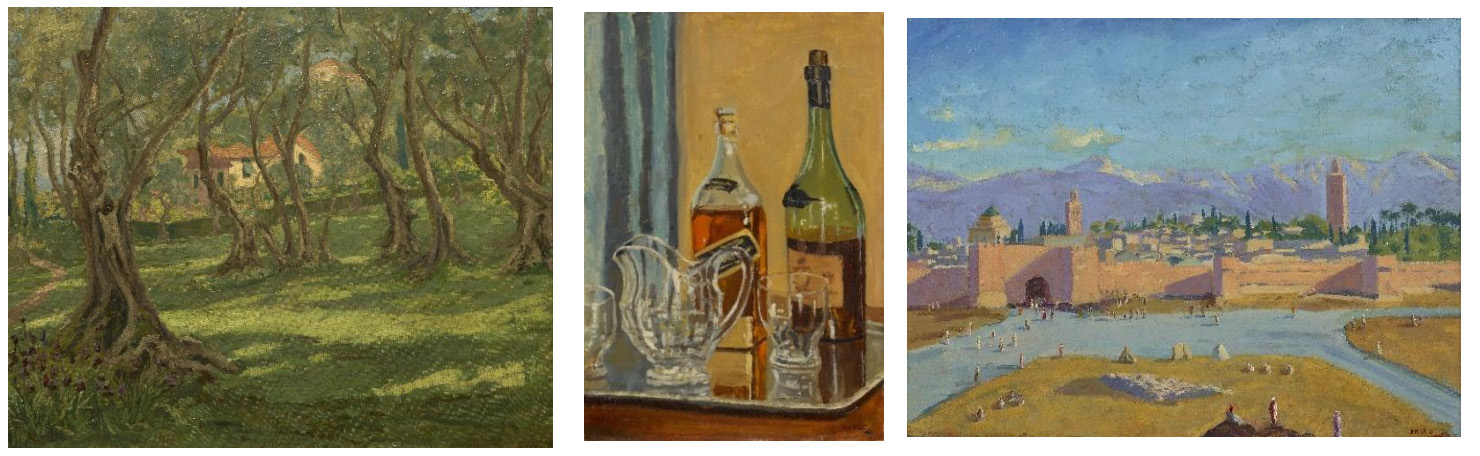
The Ancient Olive Grove at La Dragonnière, Cap Martin (1937); Jugs and Bottles, 1930s; The Tower of Koutoubia Mosque, 1943
Winston Churchill: The Painter
The first major retrospective of Sir Winston Churchill’s paintings in the UK since his death, this special exhibition at the Wallace Collection brings together more than fifty of his works, over half of them drawn from private collections rarely accessible to the public.
The exhibition spans somber wartime scenes and radiant Mediterranean views, carefully composed still lifes and portraits, luminous Moroccan cityscapes, and deeply personal depictions of Chartwell, Churchill’s beloved home and garden. During his lifetime, some of these works were exhibited at the Royal Academy or presented as tokens of friendship and diplomatic gifts. Most, however, were painted for the sheer pleasure and challenge of the creative process.
His painting career began in the wake of tragedy. In 1915, during the First World War, Churchill helped orchestrate the disastrous Dardanelles naval campaign and the related military landings on Gallipoli, both of which saw enormous losses of life. As a result, Churchill found himself publicly and politically discredited. He was demoted to the token post of Chancellor of the Duchy of Lancaster. It seemed his political career was at an end. Devastated and despairing, Churchill retreated to a rented house, Hoe Farm, near Godalming, Surrey, with Clementine and the children.
One day in June, his sister-in-law, Gwendoline (or ‘Goonie’), was painting in the garden and, seeing Churchill’s interest, suggested he try it himself. She loaned him her young son’s paintbox. So began one of his life’s passions. Churchill took to painting, at the age of forty, with his customary gusto, seeing it as his salvation from despair – “the Muse of Painting came to my rescue.” He continued to paint for the next forty years
Though supremely confident in most areas of his life, Churchill was notably modest about his achievements as a painter. He did not claim to create masterpieces—indeed, he insisted he never had—and he did not initially intend to earn money from what he considered a pastime, unlike his writing. Yet he was not without ambition. In 1921, just six years after first taking up a brush, he reportedly sold up to six paintings exhibited in Paris under the pseudonym Charles Morin at the Galerie Druet for £30 each. In 1947, he successfully submitted two works to the Royal Academy Summer Exhibition under the name David Winter, including Winter Sunshine, Chartwell, which had won a prize in 1927.
 Chartwell: The Private Landscape
If London was Churchill’s stage, Chartwell was his refuge.
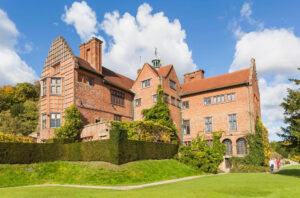
Chartwell was purchased by Winston Churchill in 1922 and served as his principal home throughout the 1920s and 1930s—a place for writing, painting, and entertaining. Today it houses the largest collection of his paintings and is filled with objects reflecting every facet of his life. The rooms remain much as they were during his lifetime, offering visitors a rare opportunity to experience the private world of one of Britain’s most consequential leaders.
The hillside gardens, which guests are encouraged to explore, reflect Churchill’s deep love of landscape and nature. They include the lakes he created, the kitchen garden, and the Marycot—a charming playhouse designed for Mary, the youngest daughter of Winston and Clementine Churchill.
Visitors can tour the house and Churchill’s painting studio, and wander the landscaped grounds, taking in the sweeping views that first inspired him to purchase the estate.
The studio at Chartwell, overlooking the Kentish landscape, remains one of the most intimate spaces in understanding Churchill’s private life.
Churchill once said, “”A day away from Chartwell is a day wasted.”
During our visit, guests will explore the home and studio and engage in conversation with Randolph Churchill on stewardship of legacy, preservation, and the living memory of Chartwell.
The War Rooms: Leadership Underground
If Chartwell reveals the private man, the Churchill War Rooms reveal the commander.
The Churchill War Rooms, part of the Imperial War Museums (IWM), encompasses the original Cabinet War Rooms—the underground bunker that sheltered Winston Churchill and his staff during the Blitz.
These historic rooms once hummed with planning and strategy, secrecy and decision-making at the highest level. Today, visitors can explore the underground headquarters for themselves, stand where Churchill and his War Cabinet met—often late into the night—and peer into the Map Room, preserved exactly as it was on the day the lights were switched off in 1945, with its books and charts left in place.
The Churchill Museum, also housed within the War Rooms, features an extensive collection of objects that illuminate Churchill’s life and legacy. Highlights include the rattle he used as a baby, a portrait study by Graham Sutherland created to mark his 80th birthday, and the flag that draped his coffin at his State Funeral.
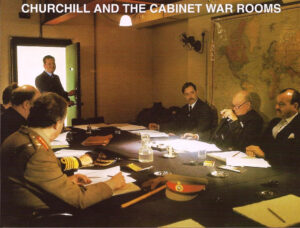 Beneath Whitehall, the Cabinet War Rooms remain preserved exactly as they were during the Second World War. Maps frozen in time. Telephones poised for decisions that would affect millions. The Map Room unchanged since 1945.
“We shall defend our Island, whatever the cost may be,” he declared in June 1940.
The War Rooms remind us that those words were not theatrical. They were operational.
From this subterranean complex, Churchill convened the War Cabinet, assessed Luftwaffe damage reports, coordinated with President Roosevelt, and steeled a nation for endurance.
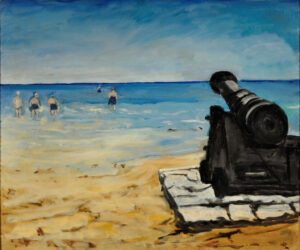 Beach at Walmer, 1938
During our guided immersion, we will examine:
- Decision-making under relentless pressure
- Civilian morale during sustained bombardment
- The mechanics of cabinet governance in crisis
- The transatlantic communications linking London and Washington
Leadership was not abstract. It unfolded in narrow corridors and dimly lit chambers beneath the streets of London.
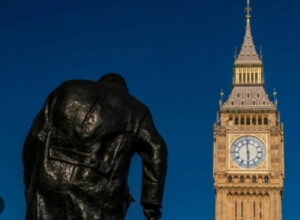 Art and Leadership
Churchill’s artistic life was not separate from his public leadership. It informed it.
Painting trained his eye in patience. It required composition and perspective. It demanded acceptance of imperfection.
“Painting a picture is like fighting a battle; and trying to paint a picture is, I suppose, like trying to fight a battle. It is, if anything, more exciting than fighting it successfully. But the principle is the same.”
 That resilience was forged not only in Parliament and war cabinets, but in quiet hours before an easel.
This London and Chartwell experience will explore:
The intersection of creativity and statesmanship
The role of discipline in sustaining leadership
The private habits that shape public courage
The preservation of historical memory through place and art
 Preserving Legacy at the Highest Level
This event benefits the International Churchill Society and supports:
- Scholarly publications and discussions
- International partnerships and outreach
- Educational programming and fellowships
- Global engagement leading into major ICS initiatives
Churchill once wrote, “We shape our buildings; thereafter they shape us.”
Chartwell shaped Churchill. His art shaped his resilience. His resilience shaped history.
We hope you will join us in London and Kent for this exceptional and intimate experience.
Adam Howard
Executive Director
202-929-0309
ahoward@winstonchurchill.org
Images courtesy of Churchill Heritage, Ltd.



Subscribe
WANT MORE?
Get the Churchill Bulletin delivered to your inbox once a month.