Finest Hour 193, Third Quarter 2021 Page 50 In The Birth of Britain, the first volume of A History of the English-Speaking Peoples, Winston Churchill writes about the conquest of [...
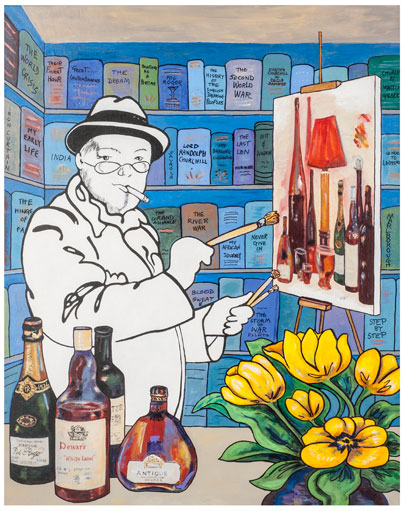
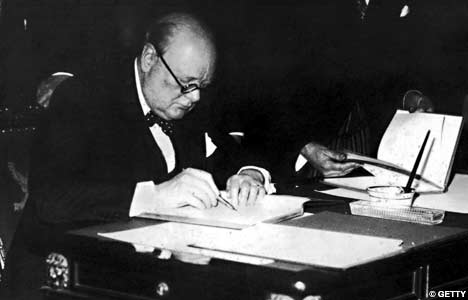
Churchill had a great gift with words. His speeches clearly demonstrate that. But he was also a prolific writer of books and articles; in his lifetime, he published more than forty books in sixty volumes, as well as hundreds of articles. The total now stands at fifty one individual works (eleven posthumous) in eighty volumes (twenty one posthumous). During his lifetime, he was a celebrated – and very well-paid – journalist and a very successful author. In 1953 he was awarded the Nobel Prize for Literature for his contribution to the written and spoken word. How did someone who purportedly wasn’t much of a student at school, manage to become so well known, so widely read and so highly regarded as a writer? For 'trivia' about Churchill’s literary life, see the Churchill Centre site . For a full list of all Churchill’s books, and a brief description of each, see the same site . A comprehensive selection of Churchill’s books – first editions, quality second-hand – as well as books about Churchill, visit , the independent bookstore in New York, the only physical bookshop devoted to his writings.
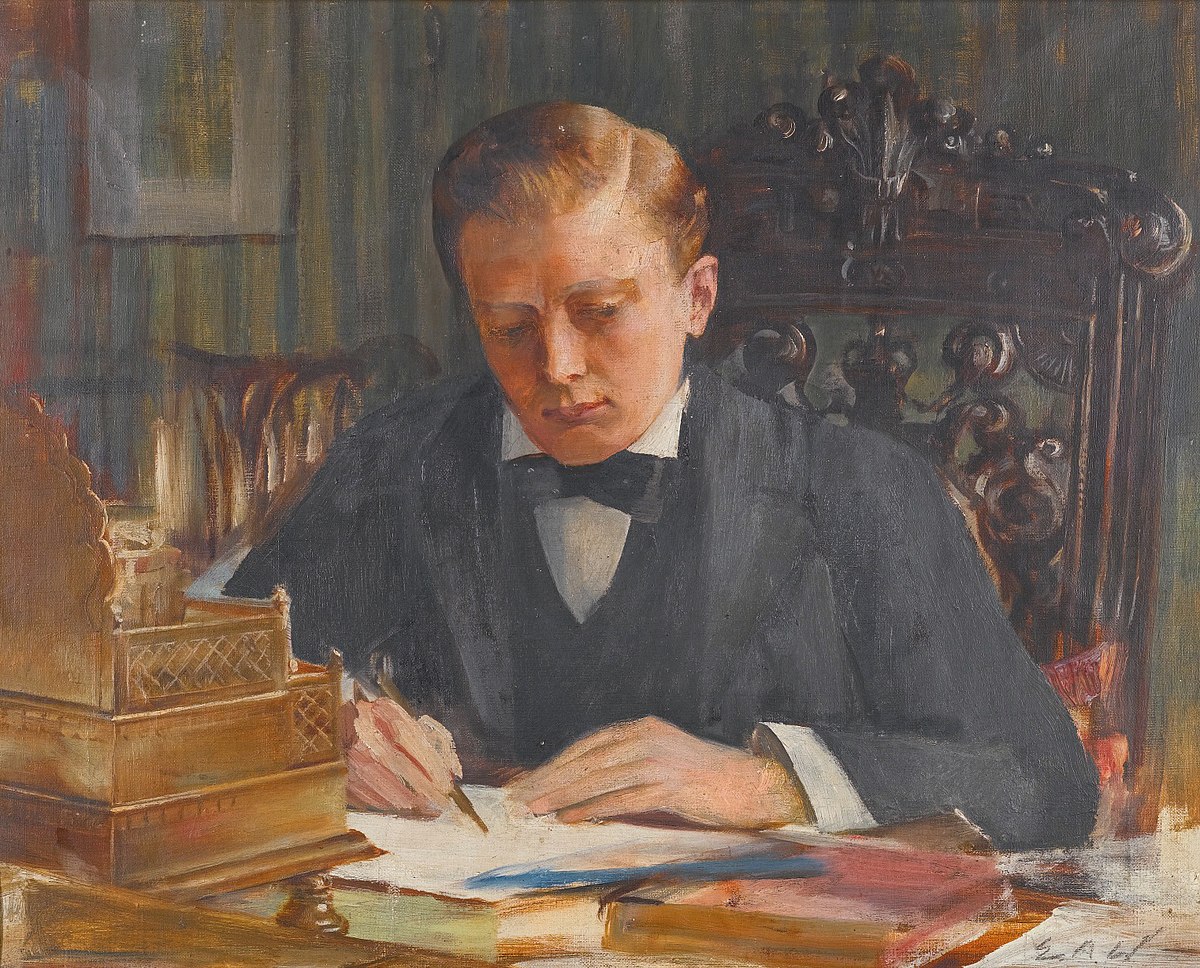
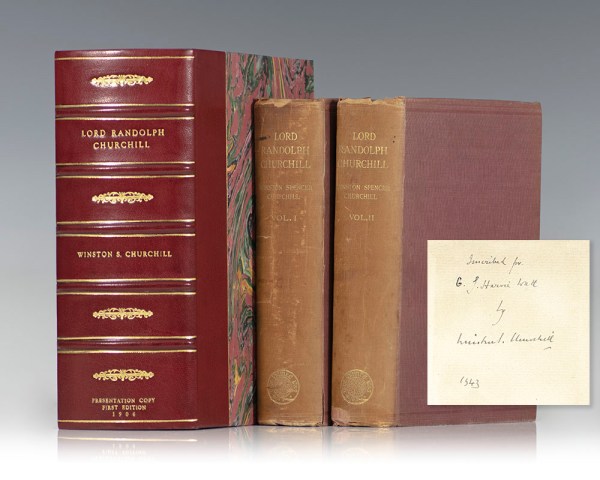
Churchill was now firmly established as a successful journalist and writer. He was commissioned, in 1903, to write a biography of his father, Lord Randolph, with an advance of £8000 – a very healthy sum. With remarkable speed, he produced two volumes and they were published in 1906. Most reviews were positive, admiring the style and Churchill’s unbiased approach but some weren’t impressed. Over the next few decades, he wrote another biography (of Marlborough, his illustrious ancestor, in four volumes), two volumes of autobiography () and three massive histories (, and ). (1908) a hunting expedition to east Africa in the autumn of 1907 turned into an enquiry into colonial affairs and resulted in a series of articles for the , which were later turned into his only travelogue (1908). (1923–31)Churchill’s memoirs covering the years 1911–1928. In October 1922, when Churchill was out of Parliament for the first time in twenty two years (apart from a few weeks in 1908), he took up writing again and embarked on his mammoth history of the First World War (and the pre- and post-war years), . It was published in 5 parts or volumes (in six books; confusingly, one ‘volume’ was spread over two books) over the years 1923 to 1931.
Out of office in the 1930s, Churchill’s could spend more time travelling and writing. Much of the former was for pleasure but he knew he could make money out of writing and he took every opportunity to turn his travels into much-needed cash. Despite being born in a palace, an independent financial base was essential (MPs only got a tiny salary in those days) and he needed funds to ensure he could live in the manner to which he’d become accustomed. He also had a growing family to support and a rundown house, Chartwell, to restore.
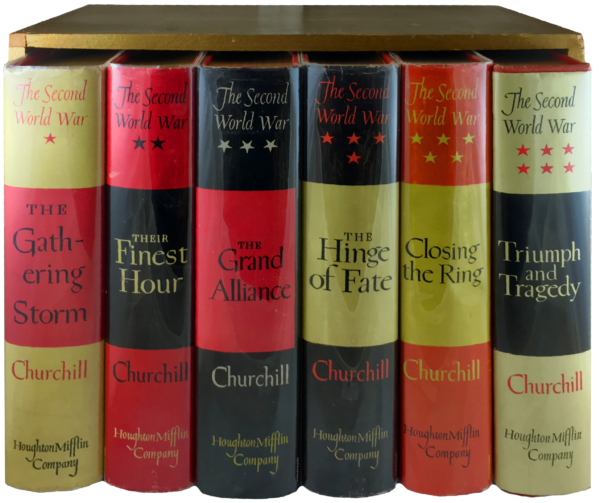
Shortly after his return from Fulton in 1946, Churchill began to write his war memoirs. With a team of researchers beavering away on his behalf, he had a very ordered (if somewhat laborious) approach to drafting and editing. He would pull together all his documents (or get his researchers to pull them together) – minutes, telegrams, letters – and then would track down material from other sources, too. Churchill would then begin to draft the text which would link all the documents together, dictating to a team of secretaries, often late into the night. Just as he did with all his speeches, he’d check drafts, check proofs, marking them up at each stage with copious corrections, determined to get the right word, the right phrase. Despite such a laborious process (or perhaps because of it), appeared relatively quickly, in six volumes, between 1948 and 1954. Churchill never claimed the memoirs were ‘history’; they were rather a contribution to history. Although their very breadth and coverage gave the impression that they were a definitive account, there were omissions, of course. was Churchill’s interpretation of the events, the work of a man seeking to place his role in the war – and in history. The books sold well, with a combined first printing of over 800,000 copies.
In the 1950s, Churchill devoted more and more time to reading the classics of literature. In 1953, he had been reading Trollope, the Brontes, Hardy and Scot, when he heard in October that he was to be awarded the Nobel Prize for Literature. This wasn’t, as some assume, for his work on (the final and sixth volume was to be published in November 1953)but in recognition of his life-long commitment to – and mastery of – the written and spoken word. He was disappointed that it was not the Peace Prize. He was in Bermuda when the prizes were to be presented by the King of Sweden in Stockholm – there was no question which event took precedence – and Clementine accepted the award on his behalf.
International Churchill Society the preeminent member organization dedicated to preserving the historic legacy of The Rt. Hon. Sir Winston Churchill.
Get the Churchill Bulletin delivered to your inbox once a month.

Join the International Churchill Society today! Membership starts at just $29/year.