
Bulletin #212 - Jan 2026
The River War Revisited
January 20, 2026
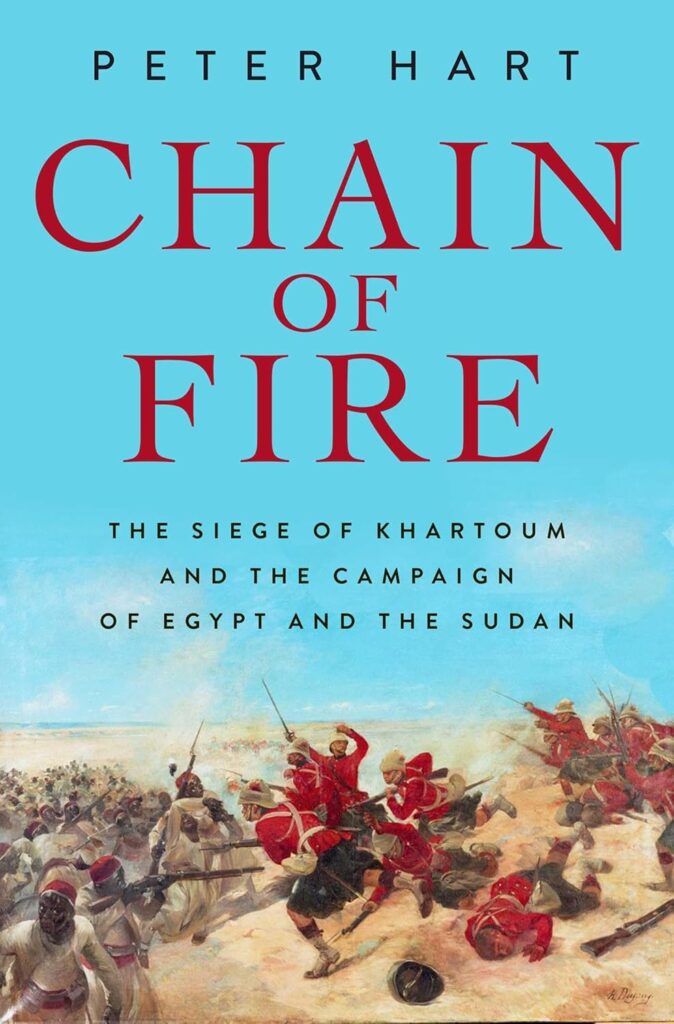
Peter Hart, Chain of Fire: The Siege of Khartoum and the Campaign of Egypt and the Sudan, Pegasus Books, 2025, 444 pages, $35.00. ISBN 978–1639369775
Review by John C. McKay
The casual reader is quick to pick up on the strategic importance of the Suez Canal, and the Panama Canal. Both are potential choke points to global commerce, important in economic and geopolitical terms, not to mention the squishy concepts of national honor and international prestige. Peter Hart adroitly captures these points in the first pages of his excellent new book Chain of Fire: The Siege of Khartoum and the Campaign of Egypt and the Sudan. Hart, who served for several years as a specialist in oral history at London’s Imperial War Museum, affords the reader a vivid, but brutally compelling account of the 1882–98 Egyptian and Sudan campaigns, which involved at its climax a young Lt. Winston Churchill, and with fallout of which the world still contends. “Today it [Sudan] is one of the most dangerous countries in the world,” Hart writes. “Perhaps [Prime Minister William] Gladstone had been right to try and stay out of it. Could the result be any worse had the British never set foot in Sudan?”
“Egypt was an anomaly within the British Empire,” Hart states at the beginning, a de facto colony known politely as a “protectorate.” The driving forces for the occupation of Egypt and later the Sudan, though reluctantly undertaken, were the need to maintain British access through the Suez Canal and the desire to eradicate the slave trade. Chain of Fire details the military operations undertaken for achieving these objectives. There were two distinct phases. First came the British occupation of Egypt and the unsuccessful attempt to rescue Col. Charles Gordon, encircled in the city of Khartoum. There followed a subsequent campaign in Sudan to avenge Gordon’s death and subjugate the Ansar, the name applied to the forces of the Mahdi, who had defeated Gordon.
The story begins in 1867, when the Suez Canal became operational. Constructed by the Compagnie de Suez, it was jointly owned by the French and the Egyptian governments. Nominally, Egypt was beholden to the suzerainty of the Turkish Sultan, but by this time it largely functioned independently. Due to his over-borrowing, spendthrift habits, and corruption, the Egyptian ruler Ismail Pasha (whose title was Khedive) sold off his shares (nearly 50%) in the canal to the British government for four million pounds in 1875. The previous year, Col. Gordon had been appointed British governor-general of the whole Sudan in order to suppress the slave trade but was provided with scant resources to achieve this lofty goal. This fact and the general business of European interference in northeastern Africa inevitably led to conflict.
While Hart correctly notes the importance of logistics, productive power, and—ultimately–the size of the respective economic bases, he also makes clear the significance of nationalistic fervor against an outside power. With Europeans effectively running Egypt, there emerged a rising sense of nationalism in the country led by Col. Ahmed Arabi. When Ismail Pasha did little to stifle the movement, he was deposed by the Ottoman Sultan at the behest of the British and the French and replaced as Khedive by his more pliable son Mehmet Tewfik.
Around the same time there began in Sudan the “whirlwind rise of Mohammed Ahmed,” who in May 1881 publicly “announced his status as the Mahdi,” a prophet whose appearance was expected by some in the Islamic world. The Mahdi’s movement was fueled by anger over the exploitation of Sudan by the Egyptians, who had haphazardly colonized the country and ruthlessly exploited it. Confusingly, by the way, the Madhi’s followers referred to their enemy as the “Turks” because the Egyptians still flew the Ottoman standard and theoretically served the Sultan.
Meanwhile, in 1882, anti-foreigner rioting erupted in the streets of Alexandria. “An estimated fifty Europeans were killed, with great damage to property and businesses across the city.” Perceiving a threat to the canal, Britain designated Lt. Gen. Garnet Wolseley as commander of any future expedition. On 11 July 1882, the Royal Navy commenced bombardment of the forts safeguarding Alexandria. Britain then effectively took over Egypt as a protectorate, and this set the stage for trouble with the Mahdi and the campaigns that followed. A young Winston Churchill described this history in detail in his two-volume history known as The River War. Later, in middle age, he retold the story in My Early Life but focused only on his own participation in the final weeks of the conflict, including the charge of the 21st Lancers at Omdurman in 1898.
Hart erases the artificial glitz that has encrusted the historical record by extensive and judicial use of primary sources, including some written accounts by the propagandists. Rather than overwhelm, however, the many citations add a sense of immediacy and relevancy, often poignant, to Hart’s incantatory prose. The abundant inclusion of excerpts from letters and writings by British soldiers and officers who served in the campaign, including Churchill, is especially noteworthy. Hart also deals equitably with the volatile issue, or moral conundrum, of how to deal with zealously fanatical opponents and leaves the reader to ponder how this same issue has been dealt with in subsequent military actions by the Great Powers.
Apart from accurately documenting the Egyptian and Sudan campaigns, Hart shows how these little wars of the Victorian Age shaped notable British leaders who went on to serve in the Second Boer War and the First World War, “some of whom are obvious, like Winston Churchill and Herbert Kitchner, but also those such as David Beatty, Douglas Haig, Ian Hamilton, Henry Rawlinson, Horace Smith-Dorrien and Charles Townsend.”
Chain of Fire warrants serious reading. More to the point, it provides current and future policy makers with the wherewithal to make considered decisions before committing military force in foreign lands. When Hart observes of Wolsey that “The depths of his self-delusion are staggering” he might equally be speaking of some modern leaders.
Col. John C. McKay USMC (Ret.) enlisted in the United States Marine Corps before attending the U. S. Naval Academy. He served two tours in Vietnam, was twice wounded in combat, and was recognized for valor.







Subscribe
WANT MORE?
Get the Churchill Bulletin delivered to your inbox once a month.