
Bulletin #212 - Jan 2026
Churchilliana
January 20, 2026
The World of Churchill Collectables
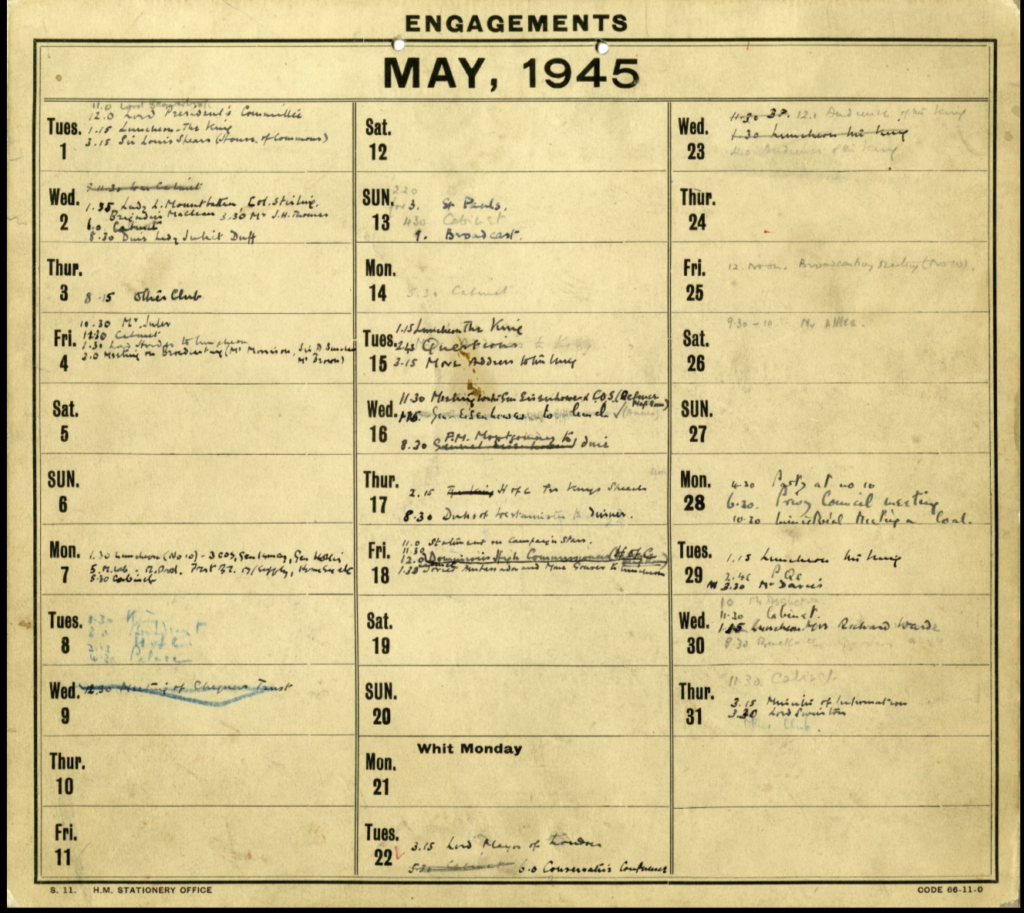
After Victory: Reading Churchill’s Calendar, May 1945
There are moments when history pauses long enough to leave a trace.
Winston Churchill’s wartime calendar cards capture those moments not through commentary or reflection, but through what is written, what is altered, and what is left unsaid. They preserve history as it unfolded, before meaning had settled and before anyone knew what would come next.
The calendar for May 1945 is one such moment.
May 8 begins clearly enough. The day opens with the King and ends at the Palace. The arc is unmistakable. Formal, ceremonial, and public, it reflects a nation marking the end of war in Europe and acknowledging the leadership that had carried it there. Victory has a shape. It has appointments. It has a beginning and an end.
Then comes May 9.
The date is crossed out.
No explanation is offered. There is no annotation to guide the reader. The crossing out itself is the record. It suggests revision rather than celebration, adjustment rather than closure. Even at the moment of victory, events were still shifting beneath the surface. The future had not yet taken form.
What follows is perhaps even more striking. After days dense with obligation and movement, the calendar opens into an unusual stretch of blankness.
For a leader whose wartime life had been defined by relentless engagement, the silence on the page feels almost jarring. It invites questions without answering them. Was this pause exhaustion, uncertainty, transition, or simply the brief stillness before the next chapter began? The calendar does not tell us. It does not need to.
This is what makes these calendar cards such extraordinary historical artifacts. They do not interpret events. They record them as they were lived. They show leadership operating inside history rather than above it. Victory does not arrive as a flourish. It arrives amid crossings-out, rearrangements, and moments where the future has not yet been scheduled.
Today, these calendars are preserved and accessible through the National Churchill Leadership Center and the digital archive at George Washington University. The archive allows readers to encounter the cards directly, to notice details like the crossed-out date, and to reflect on how history looks before it becomes settled narrative. The calendar cards themselves are part of a remarkable act of stewardship. They were donated by Steve Forbes, Chairman of Forbes Media, to the International Churchill Society, which in turn worked to make them part of the archives at George Washington University as part of the National Churchill Leadership Center. This partnership ensured not only the preservation of these rare materials, but also their availability to scholars, students, and the public. By entrusting the cards to an academic home committed to digital access, the Society helped transform a private historical artifact into a shared historical resource.
For those drawn to Churchill as a working leader rather than a finished legend, the May 1945 calendar offers something rare. It shows the end of the war not as a conclusion, but as a hinge moment. One day begins with the King and ends at the Palace. The next is erased. And then, for a brief moment, the page is quiet.
You may explore all of the calendar cards, along with transcriptions and interpretations of Churchill’s handwritten entries, through the George Washington University’s library and digital archive via this link.







Subscribe
WANT MORE?
Get the Churchill Bulletin delivered to your inbox once a month.