
Bulletin #211 — Dec 2025
Deep Dive
December 16, 2025
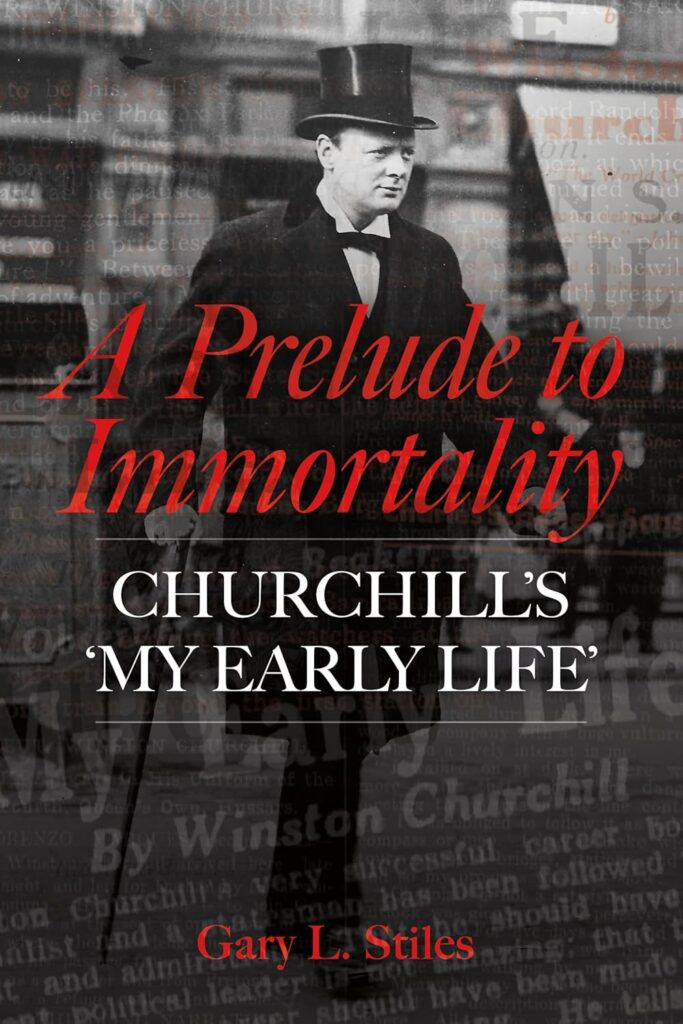
Gary Stiles, A Prelude to Immortality: Winston Churchill’s My Early Life, Unicorn, 2025, 464 pages, $52.50 / £35.00. ISBN 978–1917458276
Review by Alastair Stewart
In a 1939 radio address Winston Churchill famously described Russia as “a riddle wrapped in a mystery inside an enigma.” The same might be said of anyone who dares to undertake the excruciating instrospection required to produce an autobiography. And yet telling his story from the time of his birth in 1874 until around 1902 is a challenge that Churchill set for himself.
It also happens to be a mystery hidden in plain sight: the journalist and historian Paul Johnson estimates that Churchill wrote approximately eight to ten million words in more than forty books, thousands of newspaper and magazine articles, and at least two film scripts. So why bother at all about himself?
In A Prelude to Immortality, Gary L. Stiles examines how Churchill wrote his autobiography My Early Life to manage mounting debt and reframe his public image after being relegated to the back benches of the House of Commons and ejected as Chancellor of the Exchequer following the defeat of Prime Minister Stanley Baldwin’s Conservative government in the 1929 general election.
The Churchill name, even at that stage, was an exercise in metonymy, a byword for arrogance, the reckless churning of ideas, alleged drunkenness, and the kind of aristocratic insouciance that many believed contributed directly to the Gallipoli disaster in 1915. Robert Rhodes James famously argued in his 1970 monograph that if Churchill had died before the outbreak of the Second World War, he would have been remembered primarily as a political failure.
Written in 1930, My Early Life has a reputation for showcasing Churchillian joie de vivre, being decidedly unpolitical, and filled with anecdotes. It has stylistic flair and entertains because the author offers a no-holds-barred and jocose examination of his life with such priceless nuggets as the claim, “My education was interrupted only by my schooling.”
The central contention of Stiles is that this tone is no accident but a calculated effort to recalibrate the public’s affection through the splendour of candour by a man in his mid-fifties who appeared to be a political has-been bleating from the sidelines about issues few took seriously, including opposing dominion status for India and warning about nascent Nazi militarism. This take is unique in two ways. First, the book is dedicated to exploring the genesis of Churchill’s only foray into genuine autobiography, though admittedly he gave himself a starring role in many of his historical accounts from Malakand to The Second World War. Secondly, as a deep dive, A Prelude to Immortality provides a fresh look into Churchill’s wilderness years.
Churchill’s later writings depended heavily on collaboration with others. Stiles captures Churchill in the act of cementing himself as an undisputed author while remaining an active and calculating politician. My Early Life in all its details represented a resplendent exercise in public relations, from the price of the book to the various editions produced and the distribution list for inscribed copies. Thus did Churchill successfully regenerate both his public image and his personal finances.
In writing a history of this transformative work, Stiles has produced an encyclopaedic anatomy that is exhaustively sourced, visually led, and unapologetically granular. A Prelude to Immortality includes beautiful images of many different editions of the book, extensive notes and appendices, a thorough index, a spectacularly calculated list of signed and dedicated copies, translations, global reviews, and even an array of citations from the vast and eclectic group of people who have referred to the book themselves.
By taking readers through these and the excruciatingly exact details of paratextual necessity, contracts, correspondence, business rates, proofs, and the generally exhausting tedium of any writing endeavour, Stiles leaves one feeling that Churchill’s wilderness years were not so peripatetic and lonely as popular culture has led us to believe. Certainly, after producing his acclaimed collection Churchill in Punch (2022), Stiles has the requisite skills not to lose himself in the magnitude of his ambition, and we are in the hands of a careful and knowledgeable guide.
My Early Life is famously funny but not frivolous. At times it is filled with great pathos, and Stiles does not burst the bubble of the affection and zest with which Churchill presented his story. Instead, Stiles provides the context for understanding the memoir in the words of his own title as A Prelude to Immortality: a masterpiece of narrative self-positioning that helped not only to rejuvenate Churchill’s political career but also to hone his ability to narrate events in a way that led to his richly deserved Nobel Prize for Literature in 1953.
We learn that Churchill seriously toyed with the idea of writing a follow up to My Early Life. Although that did not happen, Stiles has managed the near impossible and produced a companion volume that is not only valuable but utterly necessary. We can only hope that, unlike his subject, he follows up on this wonderful read with another bar-setting standard of fresh Churchillian research.
Alastair Stewart is chair of ICS Scotland.





Subscribe
WANT MORE?
Get the Churchill Bulletin delivered to your inbox once a month.