
Bulletin #209 — October 2025
Tory Blues
October 14, 2025
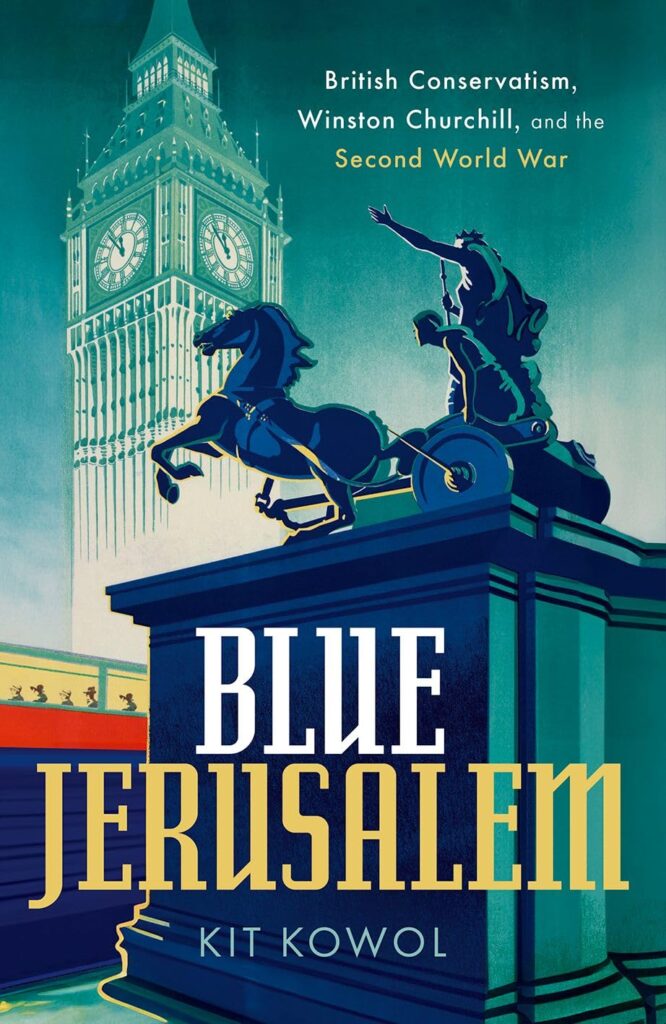
Kit Kowol, Blue Jerusalem: British Conservatism, Winston Churchill, and the Second World War, Oxford University Press, 2024, 336 pages, £27.60/$23. ISBN 978–0198868491
Review by W. MARK HAMILTON
Much has been written about the role of Britain’s Labour Party during and after the Second World War. Historian Kit Kowol’s original book stands out for its welcome attention to the overlooked impact of the British Conservative Party during this same time period. Publication of Kowol’s timely book comes as we celebrate the conclusion of the most costly war in human history and witness the rise of conservative political movements across the globe.
In the aftermath of the Second World War and the electoral triumph of the Labour Party in 1945, most historians of British political history have focused on the Left-leaning Labour Party led by Clement Attlee. Some readers of history might not object to the neglect of the ideas and the political activities of Conservatives. After all, the Conservative Party of Winston Churchill, which had expected―and planned―to continue to be in power in post-war Britain, lost the post-war election. Many could not imagine Labour Party’s electoral victory following years of a Conservative-led victory in global war.
Even before the war, the Tory Party understood that it could not completely reverse the forthcoming tides of change and promoted some reforms. One of the major ideas they proposed, however, gave a nod to the past rather than the to future. Before the Second World War, the Tories promoted the idea that Great Britain return to being a more rural nation, with the restoration of the aristocratic landlord and the “country squire.” They wanted Britain to be a solid “Christian State,” which dovetailed with Churchill’s general concern with the population’s growing lack of religious conviction, a development he perceived as weakening the British state. Though he himself wrote that he had lost his religious faith in his twenties, Churchill remained a member of the Church of England and had supported National Prayer Days during the war, believing that they fostered morale and bolstered public resolve.
Leading up to the war, the wrangling for power between the two parties extended to reaching out directly to the public—with rival book clubs pushing reading selections to bolster their party’s political views. After publisher Victor Gollancz, whose mantra was “to oppose war, to oppose inequality, and fascism.” established the Left Book Club in 1936, the Tories countered in 1937 with a Right Book Club.
Before and during the war, another policy concern taken up by Conservatives was world trade and Britain’s share of it. They asked the government for a review of manufacturing and new plans for world trade. Conservative leader Leo Amery pushed for the British Empire to be one economic unit, in part because of rising fears of U.S. economic power, which proved to be accurate. Kowol notes that though the public and its politicians believed that nothing should be done to diminish the status of the British Empire as an independent global leader, ideas for a European Federation and world government had been bandied about as early as 1929, discussed within the Conservative Party and even received Churchill’s support.
The wartime Cabinet comprised both Conservative and Labour politicians with different ideas about post-war Britain. The Conservative-led Chamberlain government had gone to war in 1939 without formal war aims. After the wartime evacuation at Dunkirk in 1940, the Conservative leadership pushed “faith, order, discipline, and respect for the military.” The shock of the historic fall of Singapore in 1942 angered the Conservatives, who saw it as a mortal blow against their post-war plans for the Empire to build Imperial armed forces, improved social services, and a radio network that would span the globe. Conservatives also strongly supported the imperialist British Navy League, which had chapters around Britain and the Commonwealth as well as strong support from business and industry.
Kowol points out that even before the war, the Conservative Party majority had a built-in fear of Communism and hoped that Germany and Soviet Russia would eventually destroy each other. Lord Beaverbrook, however, a leading Conservative politician, press lord, and close friend of Churchill, believed the United States would work eventually to diminish the British Empire. He argued for substantial aid to wartime Russia and for opening of a second front as soon as possible. Motivated by fear that Germany could prevail, Beaverbrook supported Russia because he saw it as vital to defeating Germany. His concern about America’s growing power was secondary.
Another Conservative Party issue was Britain’s ability to feed itself. The so-called “Ruralists,” who felt there must be “a return to the land,” wanted Britain to be self-sufficient in food production. The constant wartime stress of food deficiency and rationing made these fears real. Popular historian and Conservative-leaning Arthur Bryant supported agricultural self-sufficiency and said that to achieve that, the many unemployed people needed “meaningful work.” Bryant was an admirer and friend of Churchill, but the two men had a rather mixed post-war relationship. Churchill never forgot that Bryant had been an arch-appeaser and had called Churchill a “warmonger.”
Churchill had mixed feelings about the Conservative party’s political support during the war. Kowol claims Churchill distrusted the Tory leadership and Central Office. He remembered that the party had been pro-Chamberlain before the war and had been in active opposition against him. The 1945 General Election defeat was a massive shock for the Conservatives, and some believed the loss was due in part to Churchill’s aggressively negative campaign and his strong warning that if Labour were victorious, it would mean the destruction of British society. Post-election, Churchill himself received over 7,000 letters, most expressing grief and fearing for the future of Britain and the Empire.
In the political climate of the day, Conservatives saw the British Empire as a force against the fears of Communism. Kowol sees the 1945 election as being about Churchill and not about the Conservative Party. Referring to Churchill, the most prominent Conservative election poster declared, “Let him finish the job.” Conservative policies had to change with the 1945 election defeat and the post-war world. They now promoted a “New Conservatism,” and many called themselves “Tory Progressives.” They accepted the positive side of the trade unions, and some sectors of public ownership. They even openly recognized the need for welfare service, including the National Health Service.
In the shadow Labour’s electoral victory in 1945 and the triumph of post-war Labour policies, Kowol has explained the hopes and ideas of the opposition Conservatives, which ultimately were not successful. When Churchlil and the Conservatives finally did return to power in 1951, the war and the years immediately following it had changed the face of Britain forever. Most of the Conservative’s utopian policies could not be implemented, and Britain’s financial and imperial status was much diminished. Lord Beaverbrook’s fears that the United States would try to overtake Britain’s influence around the globe had come to pass, as Britain became America’s junior partner in a vastly changed post-Imperial world.
Contrary to Kowol’s arguments, many people and historians saw the Second World War as a “People’s War.” Not only were class distinctions forgotten and citizens came together to defeat Germany, but the results of the war were that Britain became a social welfare state. In Kowol’s view, however, what won the war was martial spirit, and belief in military glory, the Imperial state, and Britain being a Christian nation.
Kowol has provided his readers with a provocative piece of political history, in particular, the unexpected waning of Conservative views in the public sphere during the years following the Second World War. Yet Conservative policies and beliefs would again emerge, reaching a post-war apogee with Prime Minister Margaret Thatcher.
Blue Jerusalem is well-researched, but there could have been more information about Churchill, a promise the book’s sub-title did not fully deliver. Also, the book could be better organized, its final chapter could be stronger, and it is surprising that Kowol does not explain what “Blue Jerusalem” refers to, though readers can surmise that “blue” refers to the color of the Conservative Party in Britain, and “Jerusalem” the name of the patriotic hymn. Nevertheless, this focus on post-1945 Conservative Party politics and hopes—a topic long neglected—makes for an engaging read.
W. Mark Hamilton is author of The Nation and the Navy: Methods and Organization of British Navalist Propaganda, 1889–1914 (1986).






Subscribe
WANT MORE?
Get the Churchill Bulletin delivered to your inbox once a month.